Disclosure: This site may earn a commission if you buy through links on this page or elsewhere on the site. For bunk beds, always check the manufacturer instructions and current safety guidance before building, modifying, or using any bed.
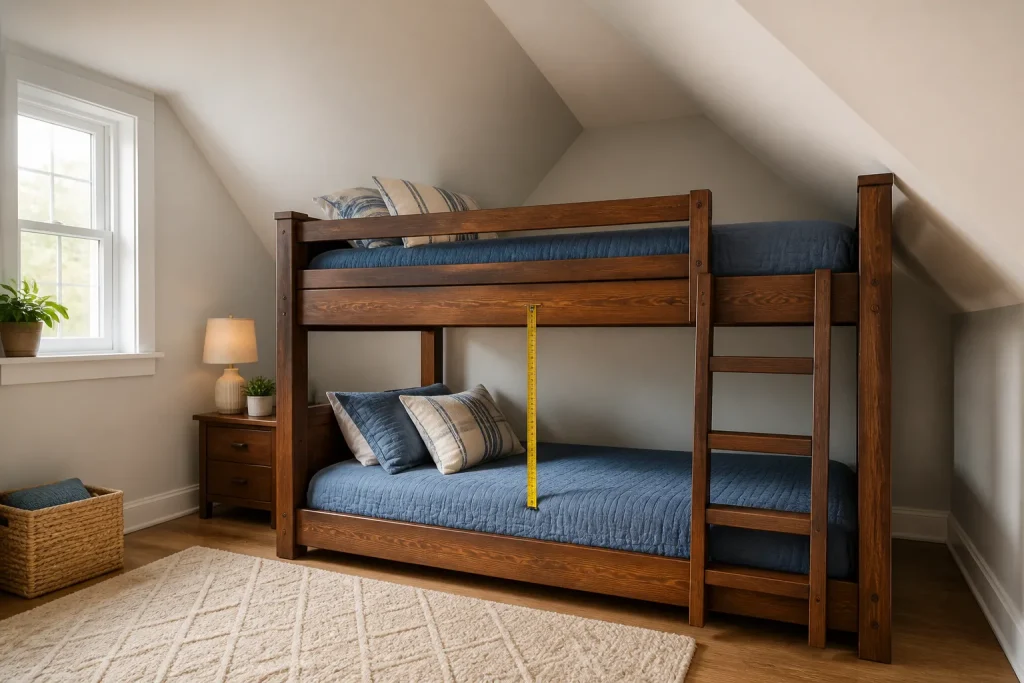
A bunk bed under a sloped ceiling can look like a smart attic-room solution, but the slope changes everything. The question is not whether the frame fits. The question is whether the upper sleeper can sit, climb, and exit without hitting the ceiling or leaning over a guardrail.
Use this guide before buying or moving a bunk bed into an attic, bonus room, cabin loft, or room with knee walls.
Table of Contents
Quick Answer
A bunk bed can work under a sloped ceiling only if the upper bunk has enough head clearance above the mattress, the guardrails still sit high enough, the ladder is not under the lowest part of the slope, and the sleeper can get in and out without ducking awkwardly. If the slope crowds the upper bunk, use a low loft, trundle, daybed, or floor-level twin instead.
| Check | What to look for |
|---|---|
| Highest point over upper bunk | Enough room to sit and turn without hitting the ceiling. |
| Lowest point near rails | No sharp slope where a sleeper climbs or exits. |
| Mattress thickness | Thicker mattresses reduce guardrail protection and headroom. |
| Ladder placement | Place ladder under taller ceiling space, away from doors and windows. |
| Ceiling fan | Do not place the upper bunk near a fan or low light fixture. |
Measure the Ceiling Where the Sleeper Actually Moves
Do not measure only at the tallest wall. Measure above the pillow area, foot area, ladder entry, and the point where a child would sit up. Sloped ceilings can lose several inches of clearance over a short distance.
Mark the mattress top height with painter tape on the wall if the room is empty. Then mark the guardrail height and the likely sitting position. This makes the usable space easier to see before moving a heavy bed.
- Measure from floor to ceiling at both ends of the upper bunk.
- Measure where the ladder meets the top bunk.
- Include the real mattress thickness.
- Check wall sconces, beams, vents, and ceiling fans.
- Leave room for bedding and normal movement.
Guardrails Still Matter Under a Slope
A sloped ceiling does not replace a guardrail. CPSC guidance says bunk beds with a mattress foundation more than 30 inches from the floor need guardrails, and those guardrails must extend at least 5 inches above the top of the mattress.
Avoid the temptation to use a thinner or lower rail just because the ceiling is close. If the guardrail cannot work correctly with the mattress and slope, the room is probably not right for a standard bunk.
Safer Layout Options
Put the Ladder at the Tallest Point
The ladder is where most awkward movement happens. Place it where the ceiling is highest and where the climber does not need to twist around a beam, dresser, or railing.
Use a Low Loft Instead of a Full Bunk
A low loft can preserve storage or play space underneath while keeping the sleeping surface lower. It is often a better fit for attic rooms than a tall bunk.
Choose a Trundle or Daybed
If headroom is marginal, a trundle or daybed keeps sleeping surfaces low and avoids the upper-bunk clearance problem entirely.
Red Flags
If any of these show up during measuring, do not force a standard bunk bed into the room. The space may still work with separate low beds or custom furniture.
- The sleeper would need to crawl into the upper bunk.
- The ladder is under the lowest ceiling area.
- A ceiling fan is close to the upper bunk.
- The mattress must be unusually thin to make the rail work.
- The bed blocks a window or emergency path.
Related Guides
For ceiling-related planning, also read ceiling height for bunk beds and canopy beds with 8-foot ceilings.
FAQ
Can a bunk bed touch a sloped ceiling?
No. The sleeper needs usable clearance for normal movement, and the bed should not rely on the ceiling for support or protection.
Is a low loft better under a sloped ceiling?
Often, yes. A low loft reduces headroom problems while still creating some usable space underneath.
Can I remove the top guardrail if the ceiling is close?
No. A close ceiling does not replace a guardrail and can make entry and exit more awkward.