Disclosure: This site may earn a commission if you buy through links on this page or elsewhere on the site. Always check the manufacturer instructions and current safety guidance before buying, building, modifying, or using bunk beds or loft beds.
A full size mattress can work well in a bunk bed, but only if the frame is built for it and the room has enough clearance. The main details to check are mattress dimensions, mattress thickness, guardrail height, and the bunk bed’s stated weight limit. Those four factors do more to determine comfort and fit than the label on the mattress alone.
This guide covers the practical steps: how a full size mattress compares with other bunk bed sizes, what thickness is usually easier to live with, how to measure the bed frame, and what to plan for in a kid’s room, teen room, or guest space.
Table of Contents
Quick Answer
A full size mattress for a bunk bed is a good choice when the frame is specifically made for full mattresses, the mattress height stays within the bunk bed’s limit, and you leave enough clearance above the top bunk for safe sitting and movement.
| Decision | Practical guidance |
|---|---|
| Confirm frame size | Buy only if the bunk bed is labeled for a full or full-over-full mattress size. |
| Check thickness | Match the mattress height to the bunk bed’s maximum mattress thickness, especially on the top bunk. |
| Measure clearance | Leave enough space from mattress top to guardrail and ceiling for safe use and bedding. |
| Check support | Use the slat system or foundation the manufacturer recommends; do not assume any full mattress will work. |
| Plan the room | Make sure the mattress size still leaves room for ladders, steps, drawers, and walkways. |
What a full size mattress means in a bunk bed
A standard full mattress is typically 54 inches wide by 75 inches long. In a bunk bed, that size is common for full-over-full layouts and some mixed-size designs. It gives more sleeping width than a twin, which can be useful for older kids, teens, and occasional adult use.
The key point is that a bunk bed is not just a frame with two sleeping surfaces. It is a size-specific structure with rail heights, ladder placement, and weight limits built around a particular mattress footprint and thickness. A full mattress that is comfortable on a platform bed may still be too thick, too heavy, or too wide for a bunk frame.
- Standard full mattress size: 54 x 75 inches
- Common use cases: full-over-full, guest rooms, older kids, teens
- Do not substitute a different size unless the manufacturer allows it
How to measure before buying
Measure the inside opening of the bunk bed, not the outside frame. Check the usable length and width, then compare those numbers with the mattress label. Even a small mismatch can make the mattress difficult to place or cause gaps at the ends or sides.
Next, measure mattress height allowance. For top bunks, the mattress must sit low enough that the sleeper is protected by the guardrail. For bottom bunks, the issue is usually ceiling clearance or the distance from the mattress to the underside of the top bunk. Also measure doorways, stairs, and hall turns if the mattress will be delivered in one piece.
| Measurement | What to check | Why it matters |
|---|---|---|
| Frame opening | Inside width and length | The mattress must fit without forcing or overhang. |
| Mattress thickness limit | Maximum allowed height for top or bottom bunk | Too much height can reduce guardrail protection or headroom. |
| Ceiling clearance | Top bunk mattress to ceiling distance | You need room to sit up and make the bed. |
| Delivery path | Door width, stairs, hallway turns | A full mattress can be awkward to move through tight spaces. |
Choosing the right mattress thickness
Thickness matters more in bunk beds than in many standard beds. A thinner mattress often makes it easier to keep guardrails effective on the top bunk and preserves usable headroom. Many bunk bed makers set a maximum mattress thickness for that reason.
A practical thickness target for many bunk beds is often in the lower-profile range, but the correct number depends on the specific frame. If the bed uses a deep guardrail system or the mattress sits low in the frame, you may have a bit more flexibility. If the bunk is already tall or the rail opening is modest, a thicker mattress can become a problem quickly.
When a thicker full mattress may work
A thicker full mattress may be suitable on the bottom bunk if the bed height allows it and the sleeper does not need extra overhead clearance. It may also work on a full-size loft or bunk design with unusually tall rails, but only if the manufacturer says so.
Even then, keep the mattress and foundation pairing simple. A heavy memory foam mattress can be harder to move, rotate, and sheet. If the bunk bed is used in a child’s room, a lighter mattress is often easier to handle during cleaning and bedding changes.
Room planning: what changes when you choose full size
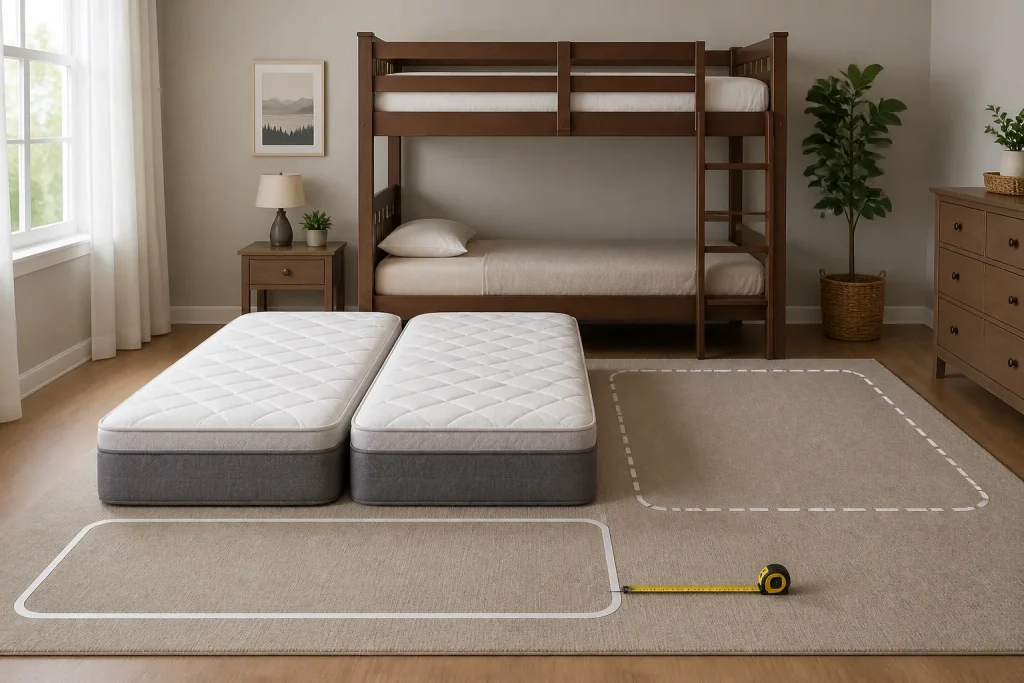
Moving from a twin to a full size mattress changes the room layout in noticeable ways. The bed takes more floor space, bedding is wider, and ladders or stairs may sit farther from the wall. In a small room, this can reduce walking space and make it harder to open drawers or closet doors.
Before buying, sketch the room with the bed, dresser, and door swing included. Make sure the bunk bed does not block vents, windows, or built-ins. If you want storage under the bottom bunk or a stair unit with drawers, account for that footprint too. A full size bunk bed can solve sleeping space problems, but it can also create traffic problems if the room is already tight.
Support, weight, and mattress type
Check the bunk bed’s support system before choosing a mattress. Some frames use slats only, some need a bunkie board, and some are designed for a specific base. Using the wrong support can affect comfort and durability, even when the mattress size is correct.
Weight matters as well. A full size mattress is usually heavier than a twin, and the weight of the mattress adds to the total load on the bunk frame. That does not automatically rule out foam or hybrid options, but it does make the manufacturer’s weight limit more important. If the bed is for two sleepers on a full-over-full bunk, total load should be considered conservatively.
- Use only the support system the bunk bed calls for
- Check both mattress weight and sleeper weight
- Avoid extra-thick toppers if they push the mattress above the rail limit
Bedding and everyday use
A full size bunk bed needs full-size sheets, but the top bunk can still be tricky to make if the mattress is thick or close to the ceiling. Low-profile mattresses are easier to dress and strip for laundry. If the bunk is for a child or teen, choose bedding that is simple to remove and replace.
For shared rooms, think about how often the bed will be changed and cleaned. A mattress protector is a practical addition, especially on a full bunk used by kids or guests. It helps keep the mattress in better condition and reduces the need for deep cleaning later.
Common mistakes to avoid
One common mistake is buying a full mattress before checking the bunk bed’s exact mattress specification. Another is focusing only on length and width while ignoring thickness. On a bunk bed, height can be just as important as footprint.
People also sometimes assume that any full mattress will work if it “sort of fits.” In a bunk bed, a close fit is not enough. The mattress should fit the frame cleanly, respect the rail height, and leave enough room for the sleeper to sit, turn, and get in and out without strain.
Related Guides
Keep planning with bunk bed games safety ideas, bunk bed weight limits, DIY quad bunk bed planning.
FAQ
Can any full size mattress be used on a bunk bed?
No. The mattress has to match the bunk bed’s stated dimensions and thickness limit. Some full mattresses are too thick or too heavy for certain bunk frames.
What is the best thickness for a full size mattress on a bunk bed?
The best thickness is the one allowed by the bed maker. Many bunk beds work better with a lower-profile mattress, especially on the top bunk.
Is a full mattress too big for a bunk bed?
Not if the bunk bed is designed for a full mattress. Full-over-full bunk beds and some loft-style beds are made for that size.
Do I need special sheets for a full bunk bed mattress?
Usually no. Standard full sheets are fine, but low-profile fitted sheets can be easier to manage if the mattress is thick or the top bunk is tight to make.
Should I use a box spring with a full size bunk bed mattress?
Usually not unless the bunk bed is specifically designed for one. Most bunk beds use slats or a recommended bunkie board instead.