Disclosure: This site may earn a commission if you buy through links on this page or elsewhere on the site. Always check the manufacturer instructions and current safety guidance before buying, building, modifying, or using bunk beds or loft beds.
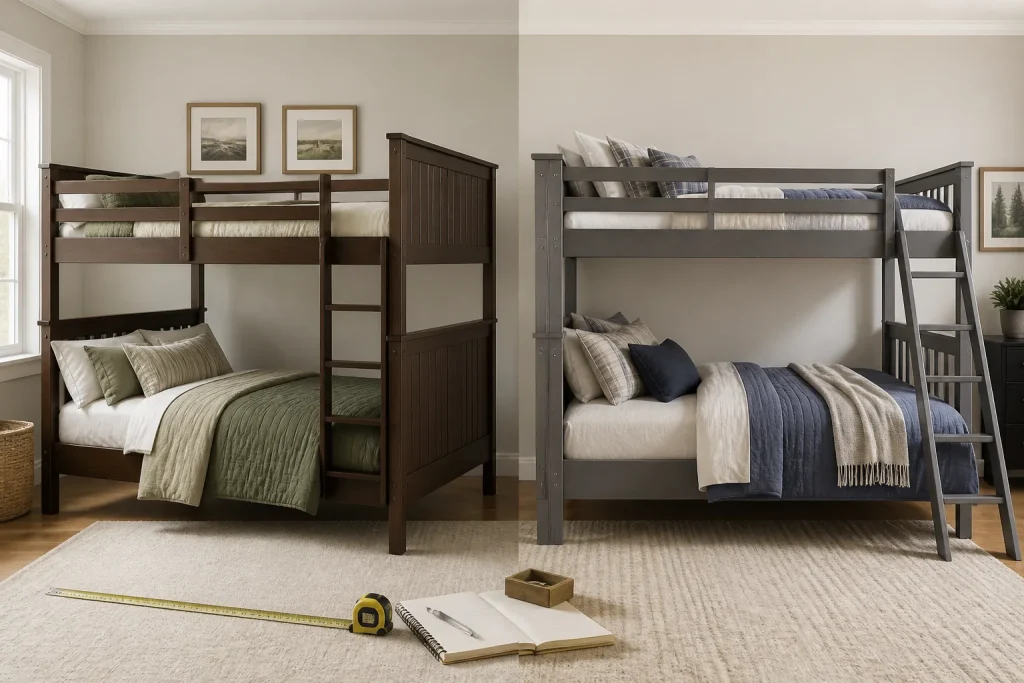
A twin over full bunk bed with ladder can save floor space, but the ladder location changes how the room works day to day. End ladders and side ladders affect walking paths, where the guardrail opening needs to be, and how easy the top bunk is to use.
This guide compares the two layouts with a practical eye: footprint, entry path, mattress fit, and daily usability. It also includes safety checks that matter before you buy, especially for top-bunk access and clearance around the ladder.
Table of Contents
Quick Answer
If the room is narrow, an end ladder often keeps the long side of the bunk bed cleaner and easier to place against a wall. If you need a clearer path in front of the bed or want the ladder away from the room’s main traffic lane, a side ladder may work better. The best choice depends on where the bed sits, how much clearance you have to climb, and whether the top-bunk opening lines up safely with the guardrail and mattress.
| Decision | Practical guidance |
|---|---|
| Choose an end ladder | Best when you want a simpler footprint, one main climbing point, and easier placement along a wall or in a corner. |
| Choose a side ladder | Best when the room needs a clearer front walkway or when the ladder should not interrupt the bed’s long side. |
| Check guardrail opening | Make sure the ladder entry does not create a gap or awkward step next to the guardrail. |
| Confirm mattress fit | Use mattresses that match the frame and do not exceed the recommended thickness for safe rail height. |
| Plan daily access | Think about sheet changes, bedtime routines, and who will use the top bunk most often. |
| Measure the room first | Leave enough space for the ladder climb, foot placement, and a safe path around the bed. |
H2: End ladder vs side ladder: the basic layout difference
On a twin over full bunk bed with ladder, the ladder can be placed at the end of the bed frame or along one side. That single choice changes how the bed sits in the room and how people move around it.
An end ladder usually means you climb from the foot or head end of the bunk. A side ladder moves the access point to the long side, which can help or hurt depending on the room shape, nearby doors, and how much open floor space you have.
- End ladder: access from the short side of the bunk.
- Side ladder: access from the long side of the bunk.
- The bed footprint may be similar, but the usable room layout is not.
H2: Floor space and room planning
The frame size of a twin over full bunk bed does not change just because the ladder moves, but the usable space around it does. That matters in small bedrooms, shared rooms, and guest rooms where every walking lane counts.
An end ladder often leaves one long side of the bed more continuous, which can be helpful if you want the bunk pushed near a wall or need one side open for a dresser. A side ladder may make the bed easier to reach from the room’s center, but it can also interfere with a narrow passage if the ladder projects into a traffic path.
| Room factor | End ladder | Side ladder |
|---|---|---|
| Narrow room | Often easier to place against a wall | May crowd the walkway |
| Corner placement | Usually simpler | Can work if the side remains open |
| Main traffic lane | Keeps the long side cleaner | May interrupt movement |
| Access to top bunk | Straightforward from one end | Often easier if the side is open |
H2: Entry path and daily usability
Daily use matters as much as footprint. A ladder that looks fine on a floor plan can feel awkward once people start making beds, changing sheets, or climbing up at night.
An end ladder tends to create a more predictable entry path. That can be useful for younger children or for adults who want the climb to feel direct and consistent. A side ladder can make the top bunk easier to reach if the room layout naturally opens along the long side, but it may also place the climber closer to furniture, windows, or wall decor.
H3: Questions to ask before choosing the ladder location
Will the ladder block a closet door, window, or bedroom door? Is the top bunk accessible without squeezing past furniture? Can someone climb up without twisting around a corner or stepping sideways into a tight gap? These practical details often decide whether the bed feels easy to use or frustrating after a week.
H2: Guardrail opening and top-bunk safety
The ladder opening and the guardrail need to work together. If the entry point is too wide, too low, or poorly aligned, the top bunk becomes harder to climb safely. The goal is a stable step-up with a clear handhold and enough protection around the mattress edge.
This is where the ladder style matters. An end ladder may leave a more obvious opening at the end of the bed, while a side ladder may create a side access point that needs careful alignment with the rail design. In either case, confirm that the opening is intentional and that the guardrail still meets the frame’s safety design once the mattress is in place.
Use conservative safety habits: keep the top mattress within the maker’s recommended thickness, avoid adding pillows or accessories that reduce rail height, and check that the ladder is secure before regular use. The top bunk should not feel like a step ladder with a loose edge or a narrow landing.
- Make sure the ladder and rail opening are designed as a pair.
- Keep the top mattress thickness within the frame’s recommended range.
- Do not use the bunk if the ladder wobbles or the entry feels cramped.
- Leave enough overhead clearance for a normal climb.
H2: Mattress fit, size, and edge clearance
A twin over full bunk bed with ladder still needs correct mattress sizing on both levels. The top mattress is usually the more sensitive fit because it affects guardrail height and the feel of the ladder entry. The bottom full-size mattress also needs to fit the frame without sliding into the ladder zone or creating a tight pinch point.
When comparing ladder styles, check whether the ladder affects how far the mattress can sit from the edge. Some designs keep the climb area more open, while others bring the ladder close to the mattress corner. That can change how easy it is to make the bed and whether sheets or blankets bunch near the access point.
Before buying, confirm three measurements: mattress length and width, mattress thickness, and the vertical opening from the top of the mattress to the guardrail. If the frame is sold with a recommended mattress height range, stay within it. If you plan to use a thicker mattress for comfort, recheck the rail height before deciding.
| Fit check | What to verify |
|---|---|
| Top mattress thickness | Should not reduce the effective guardrail height below the frame’s recommendation |
| Mattress footprint | Must match twin on top and full on bottom |
| Corner clearance | Ladder should not press into the mattress edge |
| Sheet and bedding clearance | Bedding should not interfere with ladder steps or climb space |
H2: Which ladder style is easier to live with?
For many homes, the best ladder is the one that matches the room’s traffic pattern, not just the one that looks neat on the product page. End ladders often feel simpler in bedrooms where the bunk is placed along a wall and people enter the room from one open side. Side ladders can be easier when you want the foot of the bed to stay clear or when the room opens up better along the long side.
Think about who will use the top bunk. Younger children may do better with the most direct and repeatable route. Teens and adults may care more about whether the ladder gets in the way of storage bins, desks, or a shared path to the closet. If the bed will be used every night, even small inconveniences matter more than they would in a guest room.
H3: Daily tasks that reveal the difference
Making the top bunk, changing sheets, vacuuming under the bed, and helping a child climb in at night all reveal whether the ladder location is practical. A layout that looks balanced on paper can still be awkward if it leaves little room to stand, kneel, or turn around.
H2: Practical buying checklist before you choose
A ladder choice should come after you measure the room and confirm the bed’s exact dimensions. This is especially important with a twin over full bunk bed with ladder, because the full-size lower bunk can tempt buyers to focus on sleeping width and overlook access details. The room may fit the mattress sizes but not the climb path.
Use this checklist before ordering: measure the wall length and ceiling height, map the closet and door swing, note where the ladder will land, confirm mattress thickness limits, and check weight limits for both bunks. If the frame will be used by children, review the ladder angle, step spacing, and guardrail design carefully.
For more on related planning topics, you may also want to review guidance on bunk bed safety rails and bunk bed weight limits. Those two details often matter more than ladder style alone once the bed is in the home.
- Measure wall space and room traffic before picking ladder location.
- Confirm ceiling clearance above the top bunk.
- Check door, window, and closet swings.
- Verify mattress thickness and weight limits.
- Inspect ladder attachment and step spacing before use.
Related Guides
Keep planning with bunk bed games safety ideas, bunk bed weight limits, DIY quad bunk bed planning.
FAQ
Is an end ladder or side ladder better for a twin over full bunk bed with ladder?
Neither is always better. An end ladder is often simpler in narrow rooms or corner placements, while a side ladder can work well when the long side of the bed stays open and the room has a better side walkway.
Does ladder location change mattress fit?
The mattress size does not change, but ladder placement can affect how much edge clearance you have and how easy it is to make the bed. Always follow the frame’s mattress thickness guidance, especially for the top bunk.
Is a side ladder safer than an end ladder?
Safety depends more on the frame design, ladder stability, guardrail opening, and mattress fit than on ladder position alone. A side ladder is not automatically safer; it just works better in some room layouts.
How much space should I leave around the ladder?
Leave enough room to climb without turning sideways or bumping into furniture. In practice, that means planning for full foot placement, handhold access, and a clear walking path to the bunk entrance.
Can I use a thicker mattress on the top bunk for comfort?
Only if it stays within the manufacturer’s recommended thickness and does not reduce guardrail height. A thicker mattress can make the top bunk less safe if it changes the rail-to-mattress relationship.