Disclosure: This site may earn a commission if you buy through links on this page or elsewhere on the site. Always check the manufacturer instructions and current safety guidance before buying, building, modifying, or using bunk beds or loft beds.
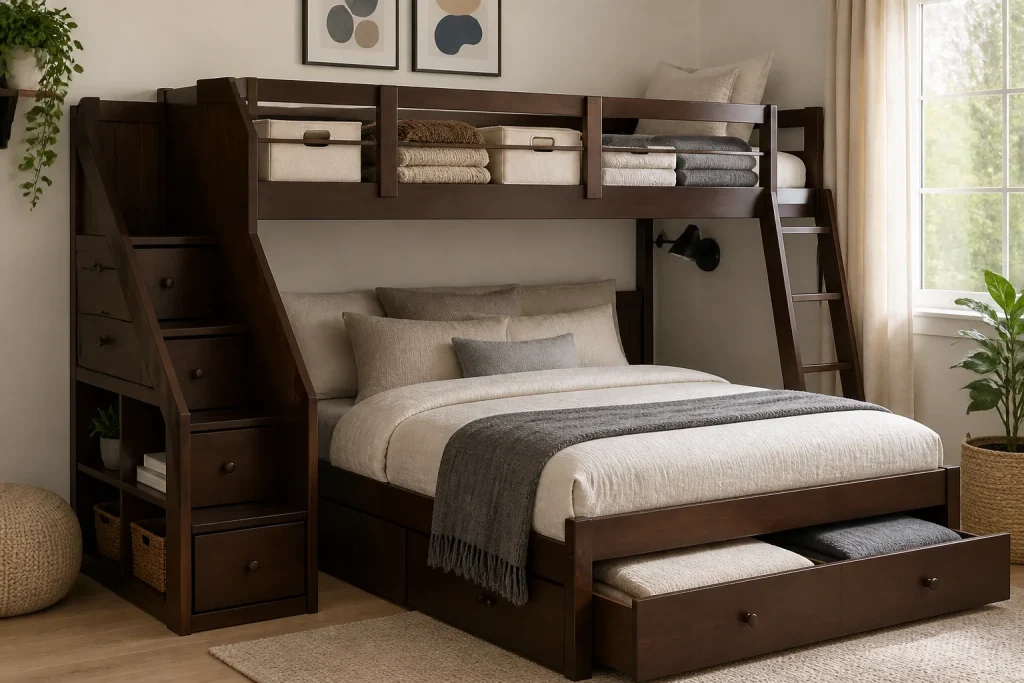
Full size bunk beds with storage can solve two problems at once: sleeping space and clutter. The right layout depends less on style and more on how the bed fits the room, how drawers open, and whether you need stairs, a ladder, or built-in shelving.
Before you choose, measure the room, note door and closet swing, and decide what the storage needs to hold. Some configurations maximize drawers under the lower bed, while others trade some drawer volume for easier access, better circulation, or a cleaner fit in a tighter footprint.
Table of Contents
Quick Answer
Choose the storage layout that matches your room shape and daily use: drawers are best when you have side or front clearance, stairs work well when you want easier access to the top bunk and deeper built-in storage, and open cubbies are best for frequently used items that do not need full-depth drawers.
| Decision | Practical guidance |
|---|---|
| Small room with one open side | Pick under-bed drawers only if there is enough pull-out clearance and the bed will not block a door, dresser, or closet. |
| Need easy top-bunk access | Choose stairs or a staircase design with integrated storage instead of a vertical ladder. |
| Shared bedroom with limited closet space | Prioritize configurations with multiple drawer bays, shelf cubbies, or stair storage for linens and clothing. |
| Room with tight walkway clearance | Use a narrower storage profile, such as side cubbies or drawers that open into an unused aisle. |
| Frequent bedding changes | Look for storage that handles blankets, pillow inserts, and backup sheets without requiring full drawer removal. |
| Lower-maintenance layout | Choose a design with fewer moving parts, fewer drawer fronts, and clear access to vacuum or sweep underneath. |
H2: Start with the room footprint, not the storage label
The phrase full size bunk beds with storage covers several different layouts, and those layouts do not all use floor space the same way. A bunk bed with wide drawers can need more usable clearance than a model with built-in shelves, even if the outside dimensions look similar on paper.
A practical layout check starts with three measurements: total wall length, total wall depth, and the open area needed to operate drawers or stairs. If a drawer needs to open 18 to 24 inches, the room must have that extra usable space in front of the drawer face. If the bed is placed near a door or dresser, that swing space becomes the deciding factor.
- Measure wall-to-wall space, then subtract baseboard trim, vents, outlets, and trim that may affect placement.
- Mark door swing, closet swing, and window clearance before selecting a storage side.
- Leave a walking lane that still feels usable after drawers or stair doors are open.
- If the bed will sit against two walls, plan for storage that opens only on the accessible side.
H2: Compare the main storage configurations
Most full size bunk beds with storage fall into a few common patterns. Some rely on drawers under the lower bunk. Others combine stairs with drawers or shelves. A few use built-in cubbies, cabinets, or side shelving instead of deep pull-out storage. Each option changes how much room you need around the bed and how easy the storage is to use every day.
For most buyers, the real comparison is not just capacity. It is the balance between storage volume, access comfort, and how much of the room remains open after the bed is installed.
| Storage configuration | Best for | Tradeoffs |
|---|---|---|
| Under-bed drawers | Clothes, bedding, toys, and seasonal items | Needs pull-out clearance and can reduce open floor space on the drawer side |
| Stair storage | Rooms that need easier top-bunk access plus storage | Takes more footprint than a ladder and can feel heavier in a small room |
| Side cubbies or shelves | Books, baskets, and items used often | Less hidden storage and usually less capacity than full drawers |
| Mixed storage layout | Families wanting both drawers and shelf access | Can be larger overall and harder to fit in very compact rooms |
| Lift-up or concealed compartments | Linen storage and larger soft goods | Less convenient for daily access if items are heavy or bulky |
H3: Under-bed drawers
Under-bed drawers are the most straightforward storage option. They work best when you want hidden storage for folded clothing, extra bedding, or items that do not need to be accessed several times a day. The key limitation is clearance. If the drawer opens toward a wall, another bed, or a narrow aisle, the drawer becomes less useful fast.
These drawers are usually easiest to live with when the bed sits along a long open wall. That leaves enough space for a full pull-out motion and makes it easier to load and unload without shifting the whole room layout.
H3: Stair storage
Stair storage is often the most comfortable option if the top bunk will be used regularly. The steps can make climbing feel less abrupt than a ladder, and the stair structure usually hides drawers, shelves, or both. The tradeoff is footprint. Stair systems take more floor area, so they work best when the room is long enough to absorb the extra depth.
If you need both storage and regular top-bunk access, stairs often make the most sense. If the room is tight and the top bunk is used less often, stairs may consume more area than the space can spare.
H3: Cubbies and open shelving
Cubbies and open shelves are useful when storage needs are small but frequent. They can hold books, alarm clocks, baskets, shoes, or bedtime items without the draw-clearance issues of deeper storage. They also make it easier to organize small items by person or category.
The drawback is visibility. Open storage looks neater when items are contained in bins, and it offers less dust protection than drawers. For shared rooms, it is a practical option when the goal is easy access rather than maximum concealed storage.
H2: Think through drawer opening clearance and traffic flow
Drawer clearance is one of the most overlooked details in bunk bed shopping. A drawer may look compact in a product photo, but if the room has only a narrow walkway, the drawer can block movement or press into another piece of furniture. This matters most in shared bedrooms, dorm-like setups, and guest rooms where the bed is placed close to a wall or closet.
When comparing full size bunk beds with storage, measure the usable open space in front of each drawer face, not just the empty room width. If the front of the drawer needs to open into a walkway, ask whether that path will still be passable when someone is using the storage. In a small room, a slightly shallower drawer that opens cleanly may be more practical than a deeper drawer that is hard to reach.
- Check how far each drawer extends when fully open.
- Make sure the opening direction does not block a door path.
- Leave room for fingers and handles so drawers can be opened without scraping nearby furniture.
- Consider whether a child or adult will use the drawer daily; frequent access favors a simpler, wider opening.
H2: Match storage capacity to what you actually need to store
Capacity sounds simple, but it depends on the kind of items you plan to store. Bedding takes more volume than folded shirts. Shoes take more depth than books. Bulky comforters, seasonal clothes, and extra pillows need different storage geometry than small personal items. A bunk bed with several shallow drawers may be more useful than one large compartment if you plan to sort items by person or category.
If the goal is reducing closet pressure, prioritize deeper enclosed storage. If the goal is just clearing the floor, open shelving or small drawers may be enough. The most efficient setup is the one that matches the item type, not the biggest storage count on the spec sheet.
| What you need to store | Storage style that usually fits best | Why |
|---|---|---|
| Folded clothing | Medium-depth drawers | Keeps garments protected and organized |
| Bedding and blankets | Deeper drawers or concealed compartments | Soft goods compress well but need more volume |
| Books and chargers | Open shelves or cubbies | Easy to reach and simple to sort |
| Shoes and accessories | Shallow drawers or bins in cubbies | Keeps small items from getting lost |
| Seasonal overflow | Largest available enclosed storage | Uses space efficiently for items not needed daily |
H2: Choose the right access style for daily use
Storage is only useful if people can reach it without friction. A bunk bed that is loaded with drawers but awkward to access may end up holding things that are rarely used. If the bed will be used by children, consider how easy it is to open each drawer and whether the top bunk can be reached safely and comfortably with the chosen access style.
Ladder access usually keeps the footprint smaller, but stairs can make the bed easier to use every day. If the room is for an older child, teen, or adult, that comfort difference may matter more than the few extra inches the stairs take up. In a smaller room, a ladder can preserve circulation, while storage stairs can replace a separate dresser if the room needs that function.
H3: Ladder versus stairs
A ladder preserves floor space and usually works best when the room is narrow. It is the leaner option, but it offers no built-in storage and can be less convenient for frequent climbing. Stairs take more space, but they are often easier to use and may add hidden storage in each step.
If the top bunk is used nightly, stairs are often worth considering. If the top bunk is used occasionally and the room is tight, a ladder may be the more practical choice.
H2: Use a simple comparison checklist before buying
When comparing models, it helps to move beyond appearance and look at a few practical questions. The best full size bunk beds with storage are usually the ones that fit the room without forcing compromise in door swing, walkway width, or daily access. A good layout should feel balanced, not crowded.
Use the checklist below to narrow the choice before you decide on finish, style, or extra features.
- Does the storage open without blocking a closet, dresser, or doorway?
- Can a person still walk comfortably when the drawer or stair storage is open?
- Will the storage hold the specific items you need, not just general clutter?
- Is the top bunk access comfortable enough for the intended user?
- Does the bed leave enough open area for a rug, desk, or play space if needed?
- Will the storage remain easy to clean around over time?
- Does the room still feel workable after the bed is installed, not just measured to fit?
Related Guides
Keep planning with safe top bunk storage ideas, bunk bed games safety ideas, bunk beds under sloped ceilings.
FAQ
What is the biggest drawback of full size bunk beds with storage?
The main drawback is usually footprint and access. Storage can reduce open floor space and may require extra clearance for drawers or stairs.
Are drawers or stairs better for a full size storage bunk bed?
Drawers are better when you want simple hidden storage and have clearance. Stairs are better when you want easier top-bunk access and can afford a larger footprint.
How much clearance do I need for bunk bed drawers?
It depends on the drawer depth and hardware, but you should plan for the full open length plus enough room to stand or walk in front of it comfortably.
Can a full size bunk bed with storage replace a dresser?
Sometimes. Deep drawers or stair storage can replace some dresser function, but the layout should match the amount and type of clothing you need to store.
What should I measure before ordering?
Measure wall length, wall depth, ceiling height, door swing, closet clearance, and the open space needed for drawers or stairs.