Disclosure: This site may earn a commission if you buy through links on this page or elsewhere on the site. Always check the manufacturer instructions and current safety guidance before buying, building, modifying, or using bunk beds or loft beds.
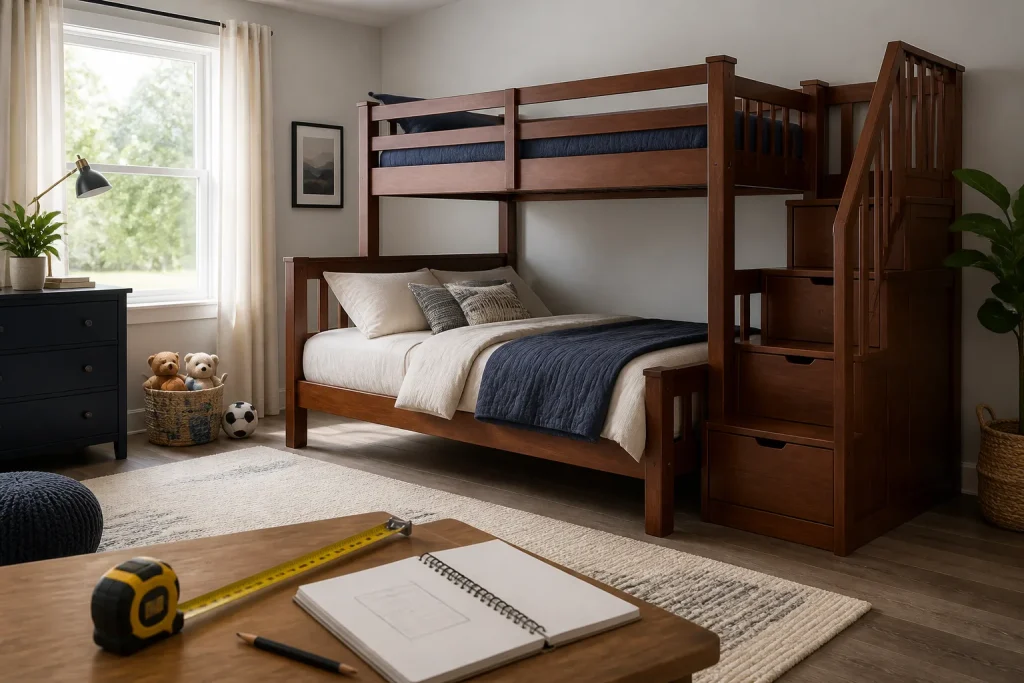
Full-size bunk beds with stairs can solve two common problems at once: sleeping space and safer access to the upper bed. The tradeoff is footprint. Stairs take more room than a ladder, and full-size mattresses add weight and width that affect layout, clearance, and assembly.
If you are planning for kids, teens, guests, or shared rooms, the right setup starts with measurements. The bed should fit the room, leave enough space to move around, and still allow safe use of the top bunk, railing, and stairs.
Table of Contents
Quick Answer
Full-size bunk beds with stairs make sense when you want easier upper-bunk access, need a more substantial sleeping surface, and have enough floor space for the stair unit. Measure ceiling height, mattress thickness, stair footprint, wall clearance, and room traffic paths before buying.
| Decision | Practical guidance |
|---|---|
| Choose stairs instead of a ladder | When users need easier climbing, steadier footing, or regular access to the top bunk, stairs are usually the better option. |
| Check ceiling height first | Confirm the top mattress will still leave safe headroom above the mattress and enough space below the ceiling and fan fixtures. |
| Measure stair footprint | Stairs often extend farther into the room than a ladder, so verify door swings, dressers, windows, and walking paths. |
| Match mattress thickness to rail height | Use the manufacturer’s mattress height limit so the top bunk rail remains effective. |
| Account for room use | In shared bedrooms, the stair side should not block closet access, nursery traffic, or nighttime movement. |
| Plan for assembly and relocation | Full-size bunk beds with stairs are heavier and harder to move than simpler bunk frames, so measure stairs, hallways, and turning spaces. |
| Review safety instructions before use | Follow the manufacturer’s assembly steps and current safety guidance for guardrails, openings, and mattress fit. |
When stairs make more sense than a ladder
Stairs are worth considering when the top bunk will be used often, when the sleeper is younger, or when the room’s users prefer a steadier climb. The step unit can feel more manageable than a vertical ladder, especially for nighttime trips, school-age children, or adults who do not want to climb a narrow rung system.
That said, stairs are not automatically better for every room. They usually require a larger footprint, and some models place drawers, shelves, or a curved stair profile along one side. That can help with storage, but it also changes how the bed must sit in the room.
- Use stairs when the top bunk will be accessed daily.
- Choose a ladder if floor space is tight and the room can tolerate a steeper climb.
- Consider stairs if the users need a more stable step surface.
- Check whether the stair side can face the room’s open area without blocking furniture.
What to measure before buying
Before you compare styles, collect room dimensions in writing. Measure the room length and width, then note ceiling height at several points if the ceiling is not perfectly level. If there is a ceiling fan, register, light fixture, vent, or slope, include that in your clearance plan.
You should also measure every path the bed will travel through during delivery and assembly: front door, hallway, stairwell, landing, and bedroom doorway. A full-size bunk bed with stairs may fit the room but still be difficult to bring inside if the stair module or side rails are long pieces.
- Room length and width
- Ceiling height and any slope or soffit
- Doorway widths and hall turning space
- Window locations, baseboard heaters, vents, and outlets
- Distance to closets, dressers, and the nearest path to the door
- Floor area needed for the stair unit on the chosen side
Key dimensions that usually affect fit
The exact measurements vary by model, so the manufacturer’s spec sheet should be your primary reference. Even so, a planning checklist helps you avoid common mistakes. Start with the overall bed length, overall width, and overall height. Then check the usable mattress size for each bunk, the maximum recommended mattress thickness for the upper bunk, and the clearance between the upper mattress and the ceiling.
For full-size bunk beds with stairs, also note the stair depth, stair width, and whether the steps have storage inside. A unit with drawers or cubbies may need additional opening space. If the stairs attach on only one side, confirm that the side you choose still allows safe bed placement against a wall where needed.
| Dimension to verify | Why it matters |
|---|---|
| Overall bed width | Determines whether the frame fits between walls or furniture |
| Overall bed length | Affects foot traffic and door clearance |
| Overall height | Important for ceiling clearance and top-bunk safety |
| Top mattress thickness limit | Helps keep guardrails effective |
| Stair footprint | Often the largest difference between a stair model and a ladder model |
| Assembly-piece length | Affects delivery through doors, halls, and stairs |
| Clearance to ceiling fixtures | Prevents contact with fans, lights, or vents |
Safety points to check before purchase
Full-size bunk beds with stairs still need the same basic safety review as any bunk bed. The top bunk should have guardrails on the sides that need them, the mattress should fit the frame correctly, and the bed should be assembled exactly as directed by the manufacturer. Do not assume a thicker mattress, an added topper, or a different base will still keep the rail height within safe limits.
If the bed will be used by children, it is especially important to follow age guidance, weight limits, and placement instructions. Keep ceiling fans away from the top bunk area, avoid placing the bunk under low-hanging lights, and make sure the stairs are clear of rugs or other trip hazards. Periodic checks are useful because bolts can loosen over time.
A simple safety checklist
Confirm the mattress height allowed for the top bunk.
Check that guardrails remain above the mattress surface after bedding is added.
Make sure stairs are wide enough to use comfortably and stay well lit.
Keep the bed away from ceiling fans, blinds cords, and hanging fixtures.
Tighten hardware after assembly and at regular intervals.
How to plan the room layout
A bunk bed with stairs works best when the room layout supports the stair side rather than fighting it. Place the stair opening where it does not interrupt closet doors, dresser drawers, or the main walking route. If the room is narrow, measure the distance from the stair edge to the nearest wall and confirm that a sleeper can still step down without bumping into furniture.
For shared rooms, think in zones. Sleeping space, storage space, and movement space should each have a clear purpose. If the stairs include drawers, those drawers need room to open fully. If the bed sits in a corner, make sure the stair side still has usable access and the lower bunk can be made up without awkward reach.
- Leave enough open space to open drawers or storage steps.
- Avoid blocking windows, vents, or closet doors.
- Plan a clear path from the stairs to the door.
- Check whether the room can handle the bed’s visual bulk as well as its physical size.
Full-size bunk beds with stairs versus other bunk styles
A full-size bunk with stairs is usually chosen for comfort and access, while a twin-over-twin or ladder-based bunk is often chosen for smaller rooms. Full-size mattresses give sleepers more width, but that also means the frame can dominate the room more quickly. The added stair unit can make the bed feel more like built-in furniture than a compact sleep solution.
If you want storage, some stair designs help you combine sleeping and organization in one footprint. If you want maximum openness, a simpler ladder model may leave more floor area available. The right answer depends on who will use the bed and how often they need the upper bunk.
- Full-size + stairs: best when comfort and easier access matter more than compact size.
- Ladder models: better when the room is narrow or the bed will be used less often.
- Storage stairs: useful when the room also needs shelving or drawer space.
- Minimal frames: better when you want the room to feel lighter and less crowded.
Buying and assembly checklist
Before you order, compare the product dimensions to your written room measurements, not just a rough estimate. Confirm whether the stair side is fixed or reversible. Ask whether mattresses are included, because the finished height can change once the mattresses are in place. If the bed arrives in multiple boxes, check the longest box length against your doorway and stairwell limits.
During assembly, do not skip the step that secures the bed to the wall if the instructions call for it. Level the frame on the floor, tighten hardware in sequence, and recheck the fit after the mattresses are installed. Once in use, inspect the bed periodically for movement, squeaks, or loose fasteners.
- Verify bed dimensions against your room sketch.
- Confirm stair orientation and whether it can be reversed.
- Check mattress size and maximum thickness.
- Measure box lengths for delivery and assembly access.
- Follow the manufacturer’s anchoring or fastening instructions.
- Inspect hardware after the bed is in use.
Related Guides
Keep planning with bunk bed games safety ideas, bunk beds under sloped ceilings, ceiling height for bunk beds.
FAQ
Are stairs safer than a ladder on a bunk bed?
Stairs can feel safer and easier to use for many people because the steps are wider and less steep than a ladder. Safety still depends on proper assembly, guardrails, mattress fit, and keeping the stairs clear and well lit.
How much ceiling height do I need for a full-size bunk bed with stairs?
The exact requirement depends on the bed model and mattress thickness. Measure the overall bed height, then make sure there is enough space above the upper mattress for safe use and comfort according to the manufacturer’s directions.
Can I use a thicker mattress on the top bunk?
Only if it stays within the manufacturer’s maximum mattress height. A thicker mattress can reduce the effective height of the guardrails and may create a safety issue.
Do stair bunk beds take up more space than ladder bunk beds?
Usually yes. The stair section adds width or depth, so the bed may need more floor area than a ladder-style bunk.
What should I measure in my room before buying?
Measure room length, width, ceiling height, doorway widths, hallways, stairwells, and the space needed for the stair unit, drawers, and nearby furniture.