Disclosure: This site may earn a commission if you buy through links on this page or elsewhere on the site. This is a planning guide, not structural engineering advice.
A California king bed frame is not just a standard king frame stretched longer. California king mattresses are usually narrower and longer than standard kings, so the frame, slats, center support, and bedding need to match the actual mattress.
Before cutting lumber, confirm the mattress dimensions, desired finished height, room clearance, and whether the frame needs to be moved through stairs or tight hallways.
Table of Contents
Quick Answer
A typical California king mattress is about 72 by 84 inches. A DIY frame should support that footprint with strong side rails, a center beam, enough legs to prevent sagging, slats or a platform matched to the mattress requirements, and a little clearance so bedding can tuck without pinching.
| Frame detail | Planning check |
|---|---|
| Mattress size | Measure the actual mattress, not just the label. |
| Inside frame opening | Allow a small amount of clearance for bedding. |
| Center support | Use a center beam and support legs for large mattresses. |
| Slats/platform | Follow mattress warranty spacing requirements. |
| Finished height | Include mattress thickness and under-bed storage. |
Start With the Mattress
Measure width, length, and height before designing the frame. Mattress dimensions can vary slightly, and a tight frame makes sheets harder to change.
If the mattress warranty requires certain slat spacing or a solid platform, build around that requirement first.
- Measure actual mattress width and length.
- Check mattress support requirements.
- Decide whether bedding tucks inside or hangs outside the frame.
- Plan clearance around nightstands and doors.
- Confirm the frame can be assembled in the room.
Support Matters More Than Style
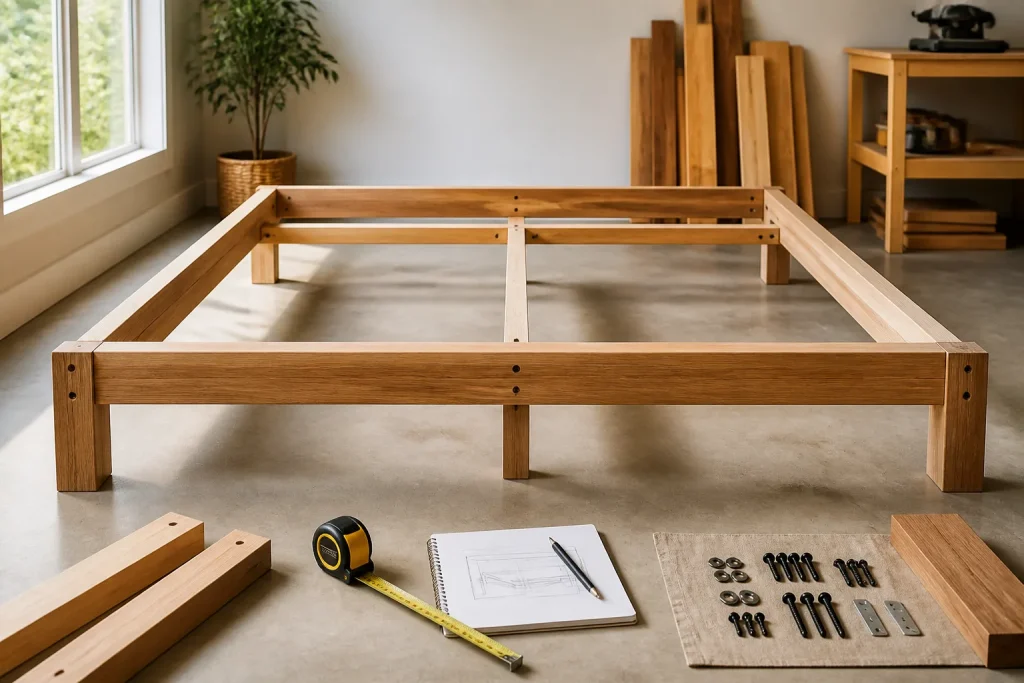
A large bed frame needs more than four corner legs. A center beam with legs down to the floor helps prevent sagging and keeps the mattress supported evenly.
Do not rely on thin decorative rails unless the design also includes real structural support.
| Part | Purpose |
|---|---|
| Side rails | Hold the mattress footprint and connect head/foot sections. |
| Center beam | Reduces sag across the wide span. |
| Support legs | Transfer load to the floor. |
| Slats or platform | Support the mattress evenly. |
| Corner brackets | Help keep the frame square. |
Common DIY Mistakes
Most mistakes come from building too tight, skipping center support, using slats spaced too far apart, or forgetting that the frame must be moved later.
If you want drawers or storage, plan them before finalizing support legs. Storage should not weaken the center support.
- Do not copy standard king dimensions.
- Do not skip center support.
- Do not make the frame so tight that sheets cannot tuck.
- Do not block floor vents or outlets.
- Do not glue large parts that may need to be disassembled later.
Room Fit and Clearance
A California king is long. Check walking paths at the foot of the bed and door swing around the frame. A beautiful frame that crowds the room will be frustrating every day.
Leave enough room to make the bed, open drawers, and move around without scraping walls.
Related Guides
For size comparisons, see California king vs two twins. For bedding fit, see queen sheets on Full XL beds.
FAQ
What size should a California king bed frame be?
Build around the actual mattress, commonly about 72 by 84 inches, plus a small amount of clearance depending on the design.
Does a California king frame need center support?
Yes. A large mattress should have a center beam and support legs or an equivalent platform system.
Can I use standard king plans for a California king?
Not directly. Standard king and California king dimensions are different, so the plan must be adjusted carefully.