Disclosure: This site may earn a commission if you buy through links on this page or elsewhere on the site. For bunk beds, always check the manufacturer instructions and current safety guidance before building, modifying, or using any bed.
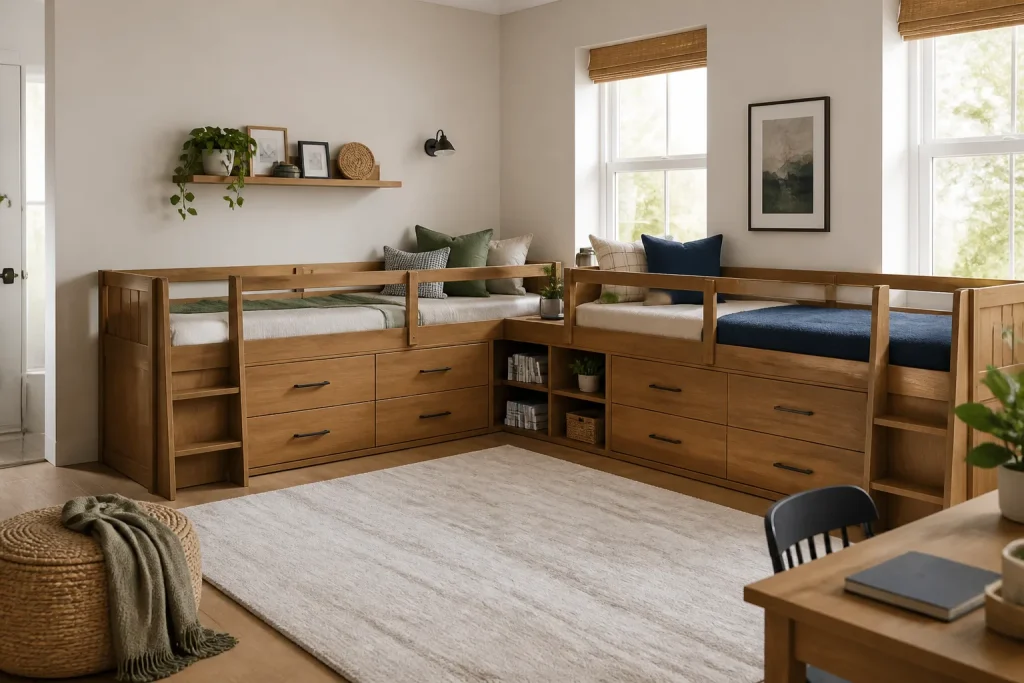
An L-shaped bed layout can open the middle of a room, separate sleep zones, and make a shared bedroom feel less crowded.
It is not automatically better than a straight bed or standard bunk. The layout only works when the corner, ladders, drawers, and walking paths are planned together.
Table of Contents
Quick Answer
L-shaped beds work best in square or corner-friendly rooms where the layout opens floor space and keeps each sleeper easy to reach. They are less useful in narrow rooms, rooms with awkward windows, or layouts where the corner blocks drawers, ladders, or bedding changes.
| Room condition | L-shaped bed fit |
|---|---|
| Square room | Often a good fit. |
| Long narrow room | A straight layout may work better. |
| Two children sharing | Can separate sleep zones. |
| Need storage | Works if drawers can open fully. |
| Low ceiling | Check top-bunk clearance before choosing a tall design. |
Start With the Corner
The corner looks like wasted space, but it can become the hardest part of the bed to clean, make, or inspect. Check whether adults can reach the inside corner without climbing on the bed.
If the bed has a top bunk, confirm that the corner does not create blocked guardrail access or awkward ladder placement.
Plan Ladders and Stairs Early
L-shaped bunks often have more ladder placement options than a standard bunk, but each option changes the room. A side ladder can block drawers. An end ladder can block a window or closet. Stairs can consume floor space.
Mark the ladder or stair footprint on the floor before buying.
| Access type | Tradeoff |
|---|---|
| Vertical ladder | Saves space but can be harder to climb. |
| Angled ladder | Easier climb but uses more floor area. |
| Stairs | Most furniture-like but largest footprint. |
| Corner access | Can look clean but may be hard to reach. |
Storage Can Make or Break the Layout
An L-shaped layout often leaves useful space under one side of the bed. Use that for drawers, shelves, or a small desk only if the furniture can open and be used without blocking the ladder path.
Avoid storing heavy items on upper rails or in places that make inspection difficult.
When a Straight Bed Is Better
If the room is narrow, if the bed blocks the only window, or if the ladder lands in the doorway, a straight bunk or twin beds may be easier to live with.
The best bed layout is the one that leaves clear paths and simple daily use.
Related Guides
For planning a build, see free L-shaped bunk bed plans. For ceiling planning, read ceiling height for bunk beds.
FAQ
Are L-shaped beds good for small rooms?
Sometimes. They help most when the room shape supports a corner layout and the ladder, drawers, and walking paths stay clear.
Can adults use L-shaped beds?
Only if the bed is rated for adult use and the mattress, frame, ladder, and room clearance all fit that use.
Is an L-shaped bunk safer than a standard bunk?
The shape alone does not make it safer. Guardrails, ladder design, mattress fit, and assembly quality matter more.