Disclosure: This site may earn a commission if you buy through links on this page or elsewhere on the site. This guide is for consumer education and screening. It is not a certification, legal opinion, or substitute for the current product manual, a recall notice, or advice from the relevant safety authority.
Last reviewed: September 11, 2026
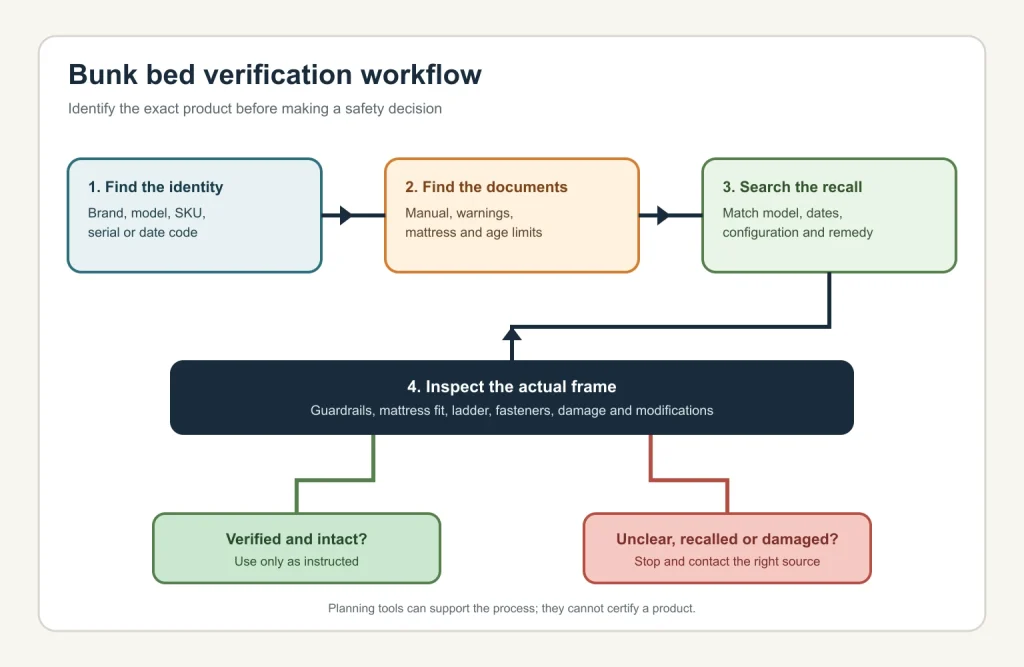
Searching for bunk bed certification is really three separate questions: does the product fall under a bunk-bed safety standard, can the seller identify the product and its instructions, and is the exact model subject to a current recall or warning? A logo or the word “certified” in a listing does not answer all three. Use the workflow below before buying a new bed, assembling a used bed, or passing a bed on to another family.
Table of Contents
Quick answer: how to verify a bunk bed
Start with the product label, model number, manufacturer, and original instructions. Check the exact model in the U.S. Consumer Product Safety Commission recall database, then compare the assembled frame with the manual: guardrails, mattress size and thickness, ladder or stairs, fasteners, warnings, and allowed configuration. If you cannot identify the model, the instructions are missing, a required guardrail is absent, or the frame has damage or improvised repairs, stop and contact the manufacturer or a qualified professional before use.
| Check | What to verify | What a pass looks like |
|---|---|---|
| Identity | Manufacturer, model, SKU or item number, production label | The details are legible and match the manual or seller record. |
| Certification evidence | Applicable standard, testing or certification documentation | The manufacturer or retailer can explain the claim; no vague logo-only claim. |
| Recall status | Exact model, date range, batch or affected configuration | The result is clear, or the manufacturer confirms the product is outside the recall. |
| Top bunk | Guardrails, mattress fit, guardrail height, ladder attachment | All required parts are original, tight, undamaged, and installed as directed. |
| Documents | Assembly instructions, warnings, mattress and weight limits | The exact manual is available before assembly or use. |
What “certified” means for a bunk bed
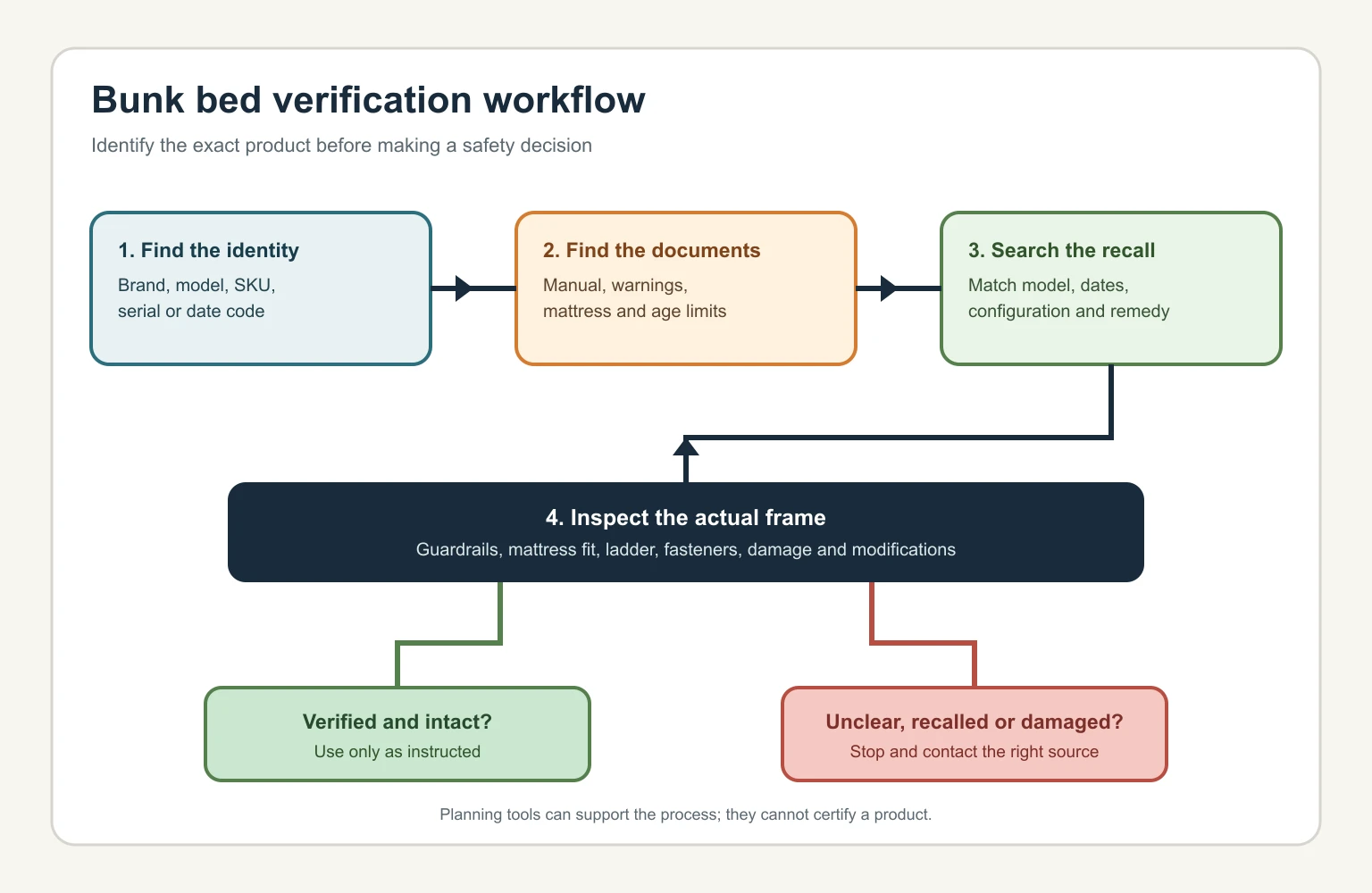
In the United States, the CPSC identifies federal bunk-bed requirements for children’s bunk beds under 16 CFR Part 1513 and general-use bunk beds under 16 CFR Part 1213. The CPSC business guidance also explains that children’s products require a Children’s Product Certificate after required third-party testing, while general-use products use a General Certificate of Conformity based on testing or a reasonable testing program. The product category, intended user, and manufacturing facts matter.
That is why a listing that says “certified” without naming the product, standard, testing route, or manufacturer documentation is incomplete evidence. A consumer does not need to recreate laboratory testing at home. The useful question is whether the seller can identify the exact model and provide credible instructions and compliance information that match the product in front of you.
The federal scope is not the same as a room-fit check
The CPSC definition used in its bunk-bed guidance turns on the height of the lower mattress foundation above the floor. A product can look like a loft or bunk bed in a listing, but the relevant legal category and intended use still need to be confirmed from the manufacturer and applicable rules. Our small-room fit calculator answers a different question: whether the complete frame, access path, and room features can work together.
Do not use a room-fit result as proof that a product complies with 16 CFR Part 1213, Part 1513, ASTM F1427, or another standard. Use the room tool for planning and the manufacturer plus official authorities for compliance.
The physical safety checks that matter most
A document check is only useful when it is followed by an inspection of the actual frame. The CPSC guidance discusses guardrails and entrapment requirements, and Health Canada’s consumer guidance emphasizes the same practical checks: all four sides of the top bunk should be protected, the mattress should fit snugly, the upper sleeping surface should remain at least 5 inches below the top of the guardrails, and the ladder should be securely attached.
- Guardrails: Check every side required by the instructions, including the side next to a wall. Do not assume the wall replaces a guardrail.
- Mattress: Use only the size and maximum thickness specified for that frame. A thicker replacement mattress changes the guardrail relationship.
- Gaps and entrapment: Look for openings created by missing rails, a wrong mattress, loose parts, or an improvised modification.
- Ladder or stairs: Confirm that the access component is the original compatible part, firmly attached, and not blocked by a door, dresser, or another bed.
- Structure: Inspect bolts, slats, joints, welds, posts, and support brackets. A crack, bent member, rusted weld, or repeated loose fastener is a stop signal.
- Warnings: Read the age, weight, mattress, configuration, and use warnings instead of relying on a retailer summary.
How to check whether a bunk bed is recalled
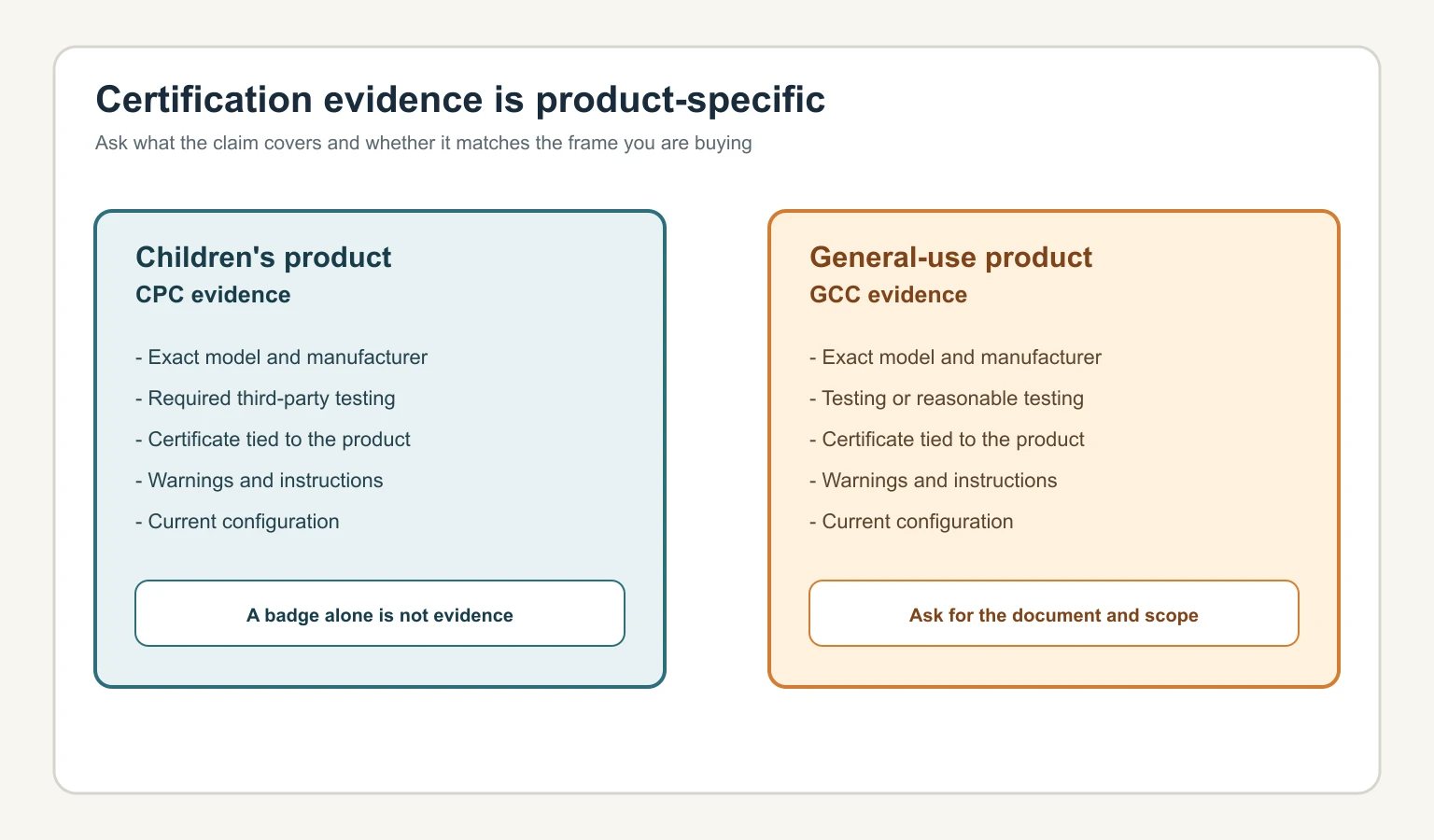
The CPSC recall page provides a search field and downloadable recall data. Search by the manufacturer, brand, model number, product name, and distinctive phrases from the label. Then open the recall notice and compare the affected model, production dates, colors, dimensions, item numbers, photos, and remedy instructions with your product. A brand-name match alone is not enough.
| If the search result says… | Do this now | Do not do this |
|---|---|---|
| The exact model is recalled | Stop using it and follow the official remedy notice. Contact the manufacturer or CPSC if the remedy is unclear. | Do not sell, donate, give away, or keep using it while waiting for a convenient repair. |
| A similar model is recalled | Compare every identifier and configuration with the notice and ask the manufacturer for written clarification. | Do not treat a close-looking photo as proof either way. |
| No result appears | Keep the model and label details, check the manufacturer, and recheck periodically because recall data changes. | Do not interpret no search result as a guarantee of safety. |
| The model cannot be identified | Ask the seller or manufacturer for instructions and identity information; avoid use until the frame is identified. | Do not guess based on the color, mattress size, or a marketplace title. |
| The remedy is unavailable | Follow the official notice and contact the agency or manufacturer for current instructions. | Do not improvise a repair or pass the product to someone else. |
CPSC says its recall data is updated weekly, while remedy information may change daily. That makes the official page the right place for a current lookup and makes a static article unsuitable as an exhaustive recall list. This article gives you the process; the live notice controls the action.
What information to photograph before you search
A five-minute documentation pass can save hours later. Photograph the complete bed, the label, the ladder or stair connection, the mattress label, and any warning label. Write down every number exactly, including hyphens and letters. Keep the receipt, listing, assembly manual, and seller messages in the same folder.
- Brand or manufacturer name as printed on the product.
- Model, SKU, item, serial, lot, or date code.
- Retailer, marketplace seller, and approximate purchase date.
- Frame type and configuration, such as twin-over-twin, loft, L-shaped, desk, or stairs.
- Mattress size and thickness currently installed.
- Any missing, replaced, drilled, cut, painted, or modified part.
Second-hand bunk beds need a higher evidence standard
A used frame may be safe, but its history is often incomplete. Health Canada specifically advises caution with second-hand bunk beds, including checking for original instructions, warning labels, attached guardrails, a secure ladder, a snug mattress, and a solid frame. Its guidance also warns against DIY fixes and recommends original manufacturer parts.
For a used bed, make the decision in this order: identify the model, find the manual, check the recall database, inspect the frame, and only then consider price or cosmetic condition. If the seller cannot provide the model or instructions, price is not a substitute for evidence. A missing bracket or homemade guardrail can change the entrapment and structural behavior of the whole bed.
A printable 10-minute verification checklist
- I photographed the manufacturer and model label.
- I found the exact assembly and use instructions.
- I checked the model in the official CPSC recall database.
- I checked the manufacturer’s current product and recall page.
- I verified the correct mattress size and maximum thickness.
- I confirmed the guardrails and ladder or stairs are present and original.
- I inspected bolts, slats, joints, welds, posts, and supports.
- I checked the age, weight, top-bunk, and configuration warnings.
- I did not make or accept an improvised safety modification.
- I will recheck fasteners and the ladder after assembly and during use.
When to stop and ask for help
Stop using the bed and contact the manufacturer, a qualified furniture professional, or the relevant safety authority when the model is unknown, the frame is damaged, the mattress does not fit the stated limits, a guardrail or ladder is missing, or a recall result is ambiguous. If there is an immediate fall, entrapment, or structural hazard, move people away from the bed and follow emergency guidance appropriate to the situation.
A safety article cannot inspect a product through a screen. Its job is to help you ask the right questions, preserve the identity information, and route you to the current source that controls the decision.
Conclusion
Good bunk bed certification research is not a hunt for a reassuring badge. It is an evidence chain: identify the exact product, understand the applicable standard and documentation, inspect the physical safety parts, check the current recall record, and follow the original instructions. Use that chain for new and used beds, and use the room-fit calculator separately to confirm that the layout works without blocking access.
FAQ
How can I tell if a bunk bed is certified?
Look for the manufacturer, model, warning label, and documentation that identifies the applicable standard and testing or certification basis. Ask the manufacturer or retailer for the exact product documentation. A generic “certified” claim or logo without product identity is not enough.
Is ASTM F1427 mandatory for every bunk bed?
Do not assume that one voluntary standard label answers every U.S. compliance question. The CPSC identifies federal requirements for children’s and general-use bunk beds, while ASTM standards and manufacturer documentation may also be relevant. Confirm the product category and current requirements with the manufacturer and official sources.
How do I check a bunk bed recall?
Search the official CPSC recalls page using the manufacturer, model, SKU, product name, and label details. Open the matching notice and compare the identifiers and configuration. If the result is unclear, contact the manufacturer before use or resale.
Can I use a bunk bed if it has no label?
Treat an unidentifiable bed as unverified. Ask the seller or manufacturer for the original identity and instructions. Do not guess from the appearance or modify the bed to make it fit a different manual.
Can I replace a bunk bed ladder with a homemade ladder?
Do not assume a homemade ladder is compatible. Ask the manufacturer for an original replacement or written instructions. The ladder attachment, angle, position, and surrounding openings are part of the design.
Does a recall search prove that a bunk bed is safe?
No. A recall search can identify official notices, but it cannot inspect assembly, damage, missing parts, misuse, or an incorrect mattress. Complete the physical and document checks as well.
Sources
- U.S. Consumer Product Safety Commission: Bunk Beds Business Guidance
- U.S. Consumer Product Safety Commission: Recalls and Product Safety Warnings
- U.S. Consumer Product Safety Commission: Bunk Beds Test Manual
- U.S. Consumer Product Safety Commission: Voluntary standards for bunk beds
- Health Canada: Bunk bed and loft bed safety
- Health Canada: Information for shoppers of second-hand products