Disclosure: This site may earn a commission if you buy through links on this page or elsewhere on the site. Always check the manufacturer instructions and current safety guidance before buying, building, modifying, or using bunk beds or loft beds.
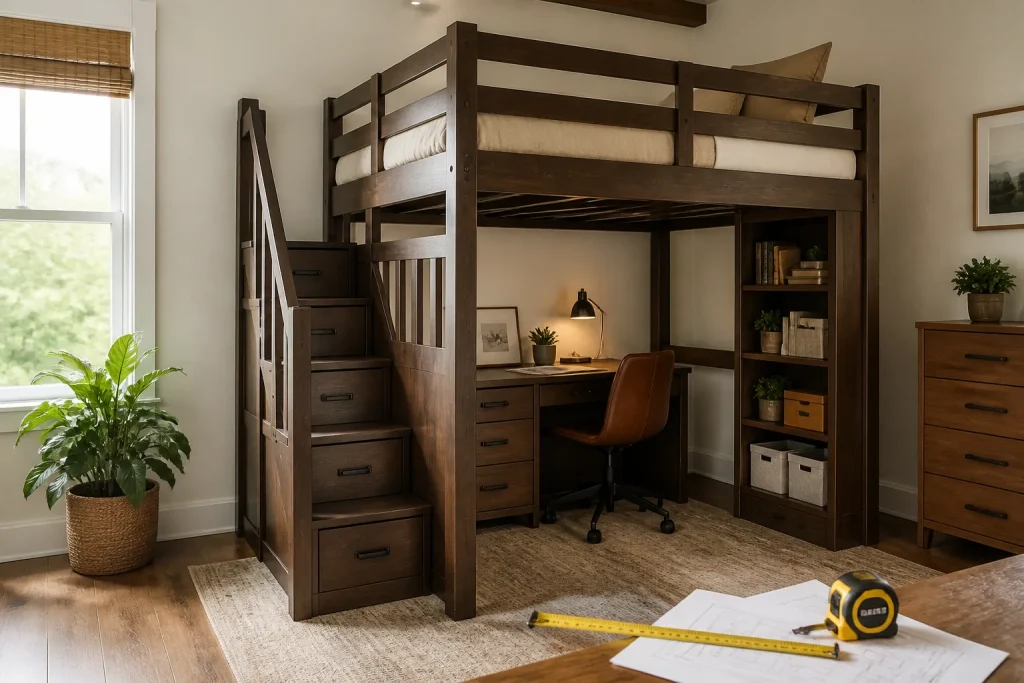
Adult staircase loft beds can solve a space problem, but the staircase changes the layout as much as the bed itself. Before you buy, measure the stair footprint, check tread depth and angle, confirm the sleeping-height headroom, and review the manufacturer’s load rating for both the bed and stairs.
This guide focuses on the practical details that matter in real rooms: how much floor space the stairs take, whether the steps are comfortable for everyday use, how easy the bed is to enter at night, and which safety checks should come before style. If you are comparing options for a bedroom, studio, or guest space, these measurements are the difference between a good fit and a frustrating one.
Table of Contents
Quick Answer
For most adults, the best staircase loft bed is the one that fits the room without crowding circulation, has comfortable treads, provides enough headroom above the mattress, and lists clear weight limits for both the sleep platform and the staircase. Prioritize safe access, stable construction, and enough clearance to sit up without bumping your head.
| Decision | Practical guidance |
|---|---|
| Stair footprint | Measure the full stair projection, including landings or storage drawers, before you plan the room layout. |
| Tread comfort | Choose wider, deeper steps with a non-slip surface if you will use them daily or at night. |
| Headroom | Check the distance from mattress top to ceiling and to any sloped walls or fixtures. |
| Load rating | Confirm the bed frame rating and whether the staircase has its own weight limit. |
| Nighttime access | Look for stable handholds, visible step edges, and lighting near the entry point. |
What makes a staircase loft bed different for adults
A staircase loft bed is not just a loft bed with a different way to climb. The stairs change how much usable floor space you lose, how the room flows, and how easy the bed is to use every day. For adults, those factors matter more than the novelty of the design because the bed may serve as primary sleeping furniture rather than a temporary setup.
Compared with a ladder, stairs usually make access more comfortable and less awkward, especially for middle-of-the-night trips or for anyone who prefers a steadier climb. The tradeoff is footprint. A staircase takes more room on the floor, and some designs add storage drawers that increase the projection even further. If you are working with a small bedroom or studio, that footprint should be measured first, not guessed.
- Best suited for: adults who want safer-feeling access, regular nightly use, or built-in storage.
- Main tradeoff: a larger footprint than a ladder-based loft bed.
- Best buying rule: size the stairs to the room before you size the mattress.
How stair design affects everyday use
The best staircase design is the one you will use confidently in the dark, half asleep, without holding on too hard or stepping too carefully. Wider treads and a gentle rise feel more natural than steep, narrow steps. If the stairs double as drawers, make sure the drawer fronts do not interfere with the walking path or create a toe-stubbing edge.
For adult use, comfort should matter as much as style. A staircase that looks sleek but feels shallow can become annoying fast, especially if you carry bedding, a water glass, or a phone when climbing up at night.
Measure the stair footprint before you choose a layout
The staircase footprint is usually the first measurement that surprises buyers. A loft bed may fit in the room on paper, but once you include the stairs, the placement can block a closet, a window, or a door swing. Measure the bed area, then map the stair projection separately. If the staircase includes a landing, remember that the landing is part of the usable footprint.
Also check the direction of entry. Some staircase loft beds can be configured with the stairs on the left or right, while others are fixed. That detail affects where you can place the bed against a wall and how the room traffic will move around it. In a tight room, even a few inches matter.
| Measurement | Why it matters |
|---|---|
| Stair projection | Determines how much floor space you lose in front of or beside the bed. |
| Landing or drawer depth | Can extend the footprint beyond the visible stair width. |
| Door swing clearance | Prevents the stairs from blocking entry, closets, or bathroom access. |
| Window and vent placement | Helps avoid blocking light, airflow, or emergency egress paths. |
| Wall clearance | Needed for safe assembly and for avoiding contact with baseboards, trim, or outlets. |
Check tread comfort and climbing safety
Tread comfort is one of the clearest signs of whether a staircase loft bed is practical for adult use. Deeper steps are easier to plant a foot on, and a textured or non-slip surface gives more confidence when the room is dark. Narrow or steep steps may be acceptable for occasional use, but they are less comfortable if the bed is your main sleep space.
Look at the rise-to-run relationship as a whole, not just the step count. A design with more gradual steps usually feels safer and less tiring than one with a steep angle. Handholds also matter. Even a well-designed staircase is easier to use if the bed has a stable side rail or built-in hand grip near the upper entry point.
Headroom is as important as stair access
Adults often focus on getting up to the bed and forget the space above it. Headroom determines whether you can sit up, change clothes, or lean over the edge without feeling cramped. Before buying, measure from the floor to the ceiling and subtract the mattress thickness, bed frame height, and the clearance needed to sit comfortably. If the room has a sloped ceiling, the usable height may be much less than the maximum measurement suggests.
Headroom also affects the placement of lights, ceiling fans, and shelves. A loft bed should not sit so close to a fan or fixture that it creates a hazard. If the room has an 8-foot ceiling, compare the finished bed height carefully to avoid a space that technically fits but feels overly tight. For more on room planning, see the site’s loft bed for 8-foot ceilings guide and the ceiling height for bunk beds guide.
When in doubt, keep the setup conservative. A slightly lower loft bed with easier access and more open air can be more livable than a taller design that feels cramped at bedtime.
- Measure floor-to-ceiling height at more than one point if the room has slope or trim variation.
- Account for the mattress thickness you actually plan to use, not just the frame height.
- Leave extra space near fans, lights, and ceiling-mounted fixtures.
How to think about sleeping height and comfort
A bed that is too high can feel awkward even if it fits the ceiling. The upper surface should allow enough room to sit upright and turn over without constant contact with the ceiling. If you tend to use your bed for reading, stretching, or laptop time, keep that use case in mind when judging the height.
Review load rating, frame construction, and mattress choice
Load rating should be treated as a hard limit, not a marketing detail. A loft bed for adults should list the maximum supported weight clearly, and that rating should cover real use, including mattress weight and normal movement during sleep. If the staircase is part of the frame, check whether it has its own weight guidance or is included in the total system rating.
Construction details matter because a staircase bed puts a different kind of stress on the frame than a simple ladder setup. Look for stable joinery, secure fasteners, and a design that minimizes wobble when someone climbs. Metal frames often advertise rigidity, while wood frames can offer a heavier feel and integrated storage. Either can work well if the construction is sound and the rating is appropriate.
Choose a mattress that matches the manufacturer’s thickness guidance. A mattress that is too tall may reduce guardrail effectiveness and worsen the upper-bed clearance. A mattress that is too thin may be uncomfortable and can make the sleeping surface feel less secure. If you need help matching size to frame, the site’s loft bed mattress-height content and bunk bed dimensions resources can help with planning.
| Check | What to confirm |
|---|---|
| Bed weight limit | The published maximum load for the sleeping platform, ideally with a clear adult-use rating. |
| Stair rating | Whether the stairs are part of the same weight limit or have a separate limit. |
| Mattress thickness | The allowed mattress height so guardrails remain effective. |
| Fasteners and joints | Bolts, brackets, and joinery should be specified and accessible for inspection. |
| Frame material | Wood or metal is less important than stability, hardware quality, and maintenance. |
Nighttime access and other real-world use factors
A staircase loft bed should be easy to use when you are tired, not just when you are fully awake. Nighttime access is where comfortable stairs, lighting, and layout come together. Small practical details, such as visible step edges, a nearby wall switch, or a low-glare light source, can improve everyday use more than decorative features do.
If you get up often during the night, think through the route from the bed to the floor. Are the stairs wide enough to descend without turning sideways? Is there enough room at the bottom to step off without meeting a dresser or open drawer? Is there a clear path from the bed to the door or bathroom? These questions matter in adult spaces because the bed may be used in a primary bedroom, not just a guest room.
Some staircase designs include storage drawers or shelving. That can be helpful, but it can also create congestion if the drawers open into a narrow path. Make sure the room still functions with the drawers open, not just when everything is closed.
- Add low-profile lighting near the stair entry and at the floor below.
- Check that the first step is clearly visible in darkness.
- Keep the landing area uncluttered so you do not step onto shoes, baskets, or cords.
Room planning mistakes to avoid
Do not place the stairs where they block a door, heating register, or closet access. Do not assume that a storage staircase will behave like a simple ladder in terms of space. And do not forget that opening drawers or swinging a door can change how safe the staircase feels at night.
Safety checks and practical caveats before purchase
Adult loft beds should still be evaluated with safety in mind. Confirm guardrail height, fastener tightness, and assembly requirements before purchase. If the bed will be used by someone with balance, mobility, or sleep-movement concerns, a staircase may be more appropriate than a ladder, but only if the whole frame is stable and the route is clear.
Follow the manufacturer’s assembly instructions exactly and recheck hardware after the bed has been used for a while. A well-built loft bed can loosen over time if bolts are not maintained. If the bed is placed near a wall, leave the recommended clearance so the frame does not rub, shift, or transfer movement into the wall surface.
For safety-sensitive details such as railing minimums, mattress limits, and anchoring guidance, rely on the product instructions and the applicable safety standards the site links separately. Use this article as a buying and planning guide, not a substitute for those requirements.
- Use the recommended mattress thickness and do not exceed the load rating.
- Re-tighten hardware after initial use and after moving the bed.
- Keep lights, cords, and décor away from the stair path and top opening.
When a staircase loft bed may not be the best choice
If the room is already tight, the stair footprint may be too disruptive. If the ceiling is low, headroom may be insufficient. If the user has trouble climbing even comfortable steps, a lower bed frame may be the better option. Sometimes the safer and more usable choice is not the loft bed at all, but a different layout that preserves easier access and better daily flow.
How to compare adult staircase loft beds before you buy
A simple comparison method can keep the decision grounded in measurements rather than aesthetics. Start with the room dimensions, then compare the stair footprint, the bed height, the load rating, and the mattress clearance. After that, think about nighttime use: how many steps, how stable the climb feels, and whether the room remains open enough once the stairs are in place.
If you are torn between styles, prioritize the features that are hardest to change later. Footprint, ceiling clearance, and load rating are structural decisions. Finish color, shelf layout, and bedding can be adjusted later. That is why the most practical adult staircase loft bed is usually the one that fits the room cleanly and supports comfortable daily use without forcing compromises in circulation or safety.
For shoppers comparing related setups, the site’s L-shaped bed guide may also be useful if you are evaluating different space-saving layouts for an adult room.
- Room fit first: does the full footprint leave usable walking space?
- Access second: are the stairs comfortable enough for daily use?
- Height third: can you sit up without hitting the ceiling?
- Strength fourth: does the frame have a clear adult weight rating?
- Maintenance fifth: can you access and tighten hardware over time?
Related Guides
Keep planning with loft beds for 8-foot ceilings, ceiling height for bunk beds, L-shaped bed guide.
FAQ
Are staircase loft beds better than ladder loft beds for adults?
Often yes, if comfort and nighttime access matter more than floor space. Stairs usually feel safer and easier to use, but they take more room than a ladder.
How much floor space do the stairs add?
It depends on the design. Measure the full stair projection, including any landing or storage drawers, before deciding where the bed will go.
What headroom should I look for?
Enough room to sit up comfortably above the mattress without contacting the ceiling or fixtures. Measure the actual installed height with the mattress you plan to use.
Do staircase loft beds need a higher weight rating for adults?
They need a clearly stated adult-appropriate weight rating for the whole system, and you should confirm whether the stairs have any separate limit.
Can I use any mattress with a staircase loft bed?
No. Use a mattress size and thickness that match the manufacturer’s guidance so guardrails, clearance, and stability remain appropriate.
What is the main safety issue with staircase loft beds?
Poor fit. The biggest risks come from a cramped footprint, low headroom, unstable construction, or using the wrong mattress height.