Disclosure: This site may earn a commission if you buy through links on this page or elsewhere on the site. Always check the manufacturer instructions and current safety guidance before buying, building, modifying, or using bunk beds or loft beds.
Bunk beds with storage can solve two problems at once in a small room: sleeping space and places to put clothes, bedding, books, and toys. The catch is that storage can also eat into the very floor area you are trying to save. The best layout depends on how much clear walkway you need, where the door swings, and whether the room needs daily access to drawers or only occasional access to seasonal items.
This guide compares drawer, stair, shelf, and under-bed storage layouts with a focus on circulation space. If you are shopping for bunk beds with storage for small rooms, the goal is not just adding compartments. It is choosing a configuration that keeps the room usable, easy to clean, and comfortable to move through.
Table of Contents
Quick Answer
For small rooms, the most space-efficient bunk bed storage layouts are usually built-in stairs with drawers, side-access drawers that do not block a main walkway, and open under-bed storage. Shelf-heavy designs work best only when wall space is available and you do not need wide clearance beside the bed.
| Decision | Practical guidance |
|---|---|
| Need the clearest walkway | Choose open under-bed bins or a shallow drawer layout on the room’s least-used side. |
| Need daily access to clothes | Use stair drawers or a low drawer stack that opens without crossing the main path. |
| Need book and display storage | Pick a side shelf or end shelf only if it will not narrow the entry path. |
| Need to store bulky bedding | Look for deep drawers, lift-out bins, or an open platform space with labeled containers. |
| Room has a tight door swing | Avoid drawers that open into the door zone; use stairs or opposite-side access instead. |
Why storage layout matters more than storage amount
In a small room, a bunk bed can free up floor area vertically, but the storage layout determines whether that space actually feels open. A bed with too many wide drawers on both sides may technically hold more items, yet leave too little room to walk, make the bed, or open a closet. A better design uses storage where the room can spare it and leaves the main circulation path uninterrupted.
Before comparing styles, measure three things: the room’s clear width, the door swing, and the amount of space you want to keep open for movement. In many compact rooms, a practical target is a walkway of about 24 to 30 inches where possible, with extra clearance near doors, dressers, and closet openings. If a storage layout forces you to squeeze past every day, it is usually the wrong configuration even if it has more drawers.
- Measure the full room, then subtract door swing, closet clearance, and radiator or vent locations.
- Mark a main walking path from the door to the bed and to the closet.
- Check drawer depth and opening direction before deciding on a layout.
How to read a bunk bed footprint
The footprint is not just the mattress size. It includes stairs, drawer faces, shelf overhangs, and the space needed to pull storage open. A bunk bed that is 42 inches deep on paper may require much more usable clearance if the drawers need 18 to 24 inches of pull space. That is why some compact rooms work better with stairs or bins than with broad side drawers.
Drawer layouts: best when you can spare one accessible side
Drawer storage is one of the most common ways to add function to a bunk bed. It works well for clothing, spare sheets, toys, and smaller household items. The drawback is that drawers need open floor space in front of them. If a row of drawers faces the center of the room, every use can interrupt circulation. If the drawers sit along a wall or toward the foot of the bed, they are usually easier to live with.
In small rooms, the best drawer layouts are often low and partial, not oversized. A pair of deep drawers on one side can be more practical than a full bank of drawers on both sides. The room stays easier to cross, and the bed does not feel like it is taking over every wall.
| Drawer layout | Space impact | Best use |
|---|---|---|
| Single-side deep drawers | Moderate footprint, good aisle control | Clothes, blankets, seasonal items |
| Full-width front drawers | Highest floor demand when open | Rooms with generous clearance in front |
| Low stacked drawers | Smaller visual bulk, easier access | Kids’ rooms and everyday essentials |
| Mixed drawer and open shelf base | Balanced footprint | Rooms that need both storage and a clear path |
When drawer beds work best
Drawer beds work best when at least one side of the bunk can be left open for walking. They are a good fit for rooms where the bed sits against a wall, with drawer access facing outward into a wider area. They are less suitable if the room is so narrow that a drawer would block the only path to the closet or doorway.
Stair storage: a strong choice when you need access without bending
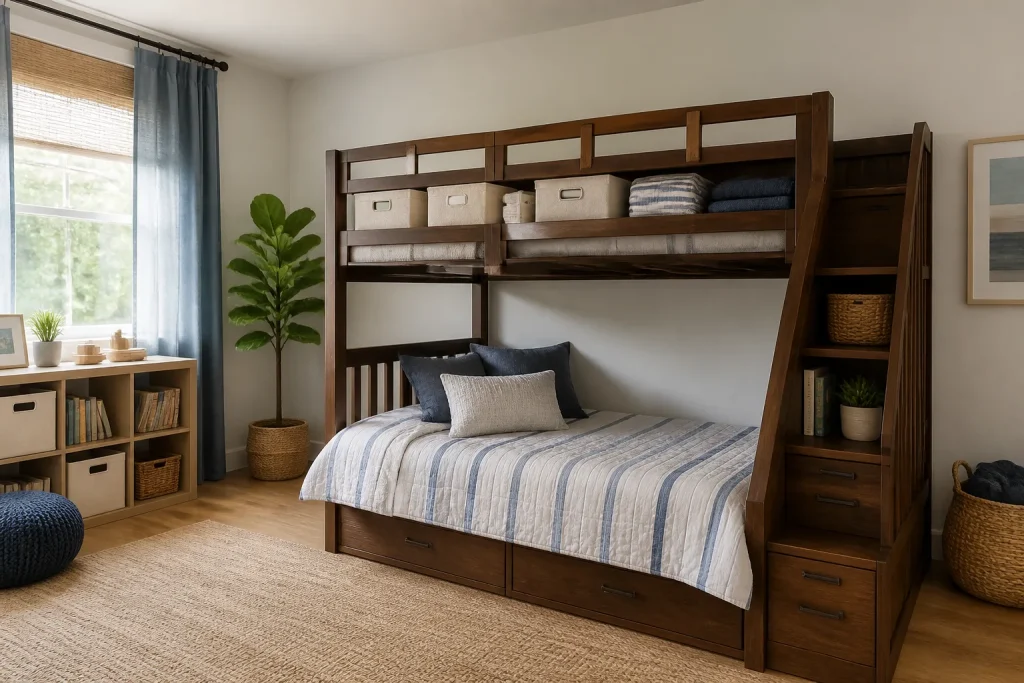
Stair storage can preserve circulation space better than a wide drawer bank because it combines vertical access with built-in compartments. Instead of opening large drawers at floor level, you use the staircase as a storage unit. This usually keeps the room more organized and reduces the need for extra dressers. It can also be easier to use daily, especially for bedding, pajamas, or small folded items.
The tradeoff is width. Stairs take up room beside the bed, so they work best when placed against a wall or in a corner where their bulk will not narrow the main walking lane. If the room is especially tight, a narrow staircase with integrated compartments may be better than a wide stair tower.
- Choose stairs if you want storage that is easy to access every day.
- Place the staircase along a wall whenever possible.
- Look for stairs with enclosed storage so the room stays visually calmer.
What to check before choosing stair storage
Measure both the staircase width and the landing area at the top and bottom. Even when stairs have drawers, doors, or lift-up compartments, the room still needs enough clearance to use them comfortably. In tight spaces, stair storage should not create a pinch point at the entry to the room.
Shelf layouts: useful for light items, but only if they do not narrow the room
Shelves are helpful for books, baskets, alarm clocks, and display items. They are often the least disruptive storage feature because they do not need as much opening space as drawers. That said, shelves can still make a small room feel crowded if they project too far into the floor area or crowd the bed entrance.
Shelf layouts work best when they are shallow and located at the ends of the bunk or on a wall side that already has little foot traffic. A small book ledge or narrow cubby can be enough to keep essentials within reach without creating a bulky storage wall.
- Use shelves for small, lightweight items rather than bulky storage.
- Keep shelf depth modest in narrow rooms.
- Avoid shelves where they will interfere with ladder access or stair entry.
Best shelf placements in compact rooms
End shelves and upper cubbies tend to preserve circulation better than wide side shelving. They store essentials without forcing you to step around the bed base. If the room already has a dresser or closet, shelves should supplement, not duplicate, that storage.
Under-bed storage: the simplest way to keep the floor looking open
Open under-bed storage is often the easiest way to preserve circulation space in a small room. Because it uses the volume below the frame rather than adding large drawer boxes, it can keep the floor visually lighter. Bins, baskets, and rolling containers can hold shoes, extra blankets, hobby supplies, and off-season clothing without needing a wide storage front.
This layout works best when you can slide containers in and out without turning the bed into a catch-all. Clear labels, matching bins, and low-profile containers help the area stay useful instead of cluttered. If the bed sits on a platform with enough height, under-bed storage can be a flexible option that does not overwhelm the room.
| Under-bed option | Room impact | Good for |
|---|---|---|
| Rolling bins | Low visual bulk, easy pull-out access | Shoes, toys, folded clothes |
| Open baskets | Lightweight and flexible | Linens, soft goods, backup supplies |
| Fabric containers | Compact and soft-sided | Seasonal clothing, lightweight items |
| No-container open space | Most open look, least structured | Tall items or temporary storage |
When under-bed storage is better than drawers
If the room is narrow and the main concern is keeping a clear path, under-bed storage usually beats wide drawers. It is especially practical when the bed is used for sleeping first and storage second. You can keep the floor open and still reduce the need for extra furniture.
How to choose a layout that preserves circulation space
The most efficient bunk bed storage layout is the one that fits the way the room is used. A child’s room with toys and frequent access often benefits from stairs or shallow drawers. A guest room may only need under-bed bins for linens. A shared room may need one storage-heavy side and one open side so two people can move around without conflict.
Think in terms of movement zones. The room needs a clear entry zone, a bed access zone, and a storage access zone. When these overlap too much, the room feels crowded even if it has enough square footage on paper.
- Prioritize one clear walking path from the door to the bed and closet.
- Keep high-frequency storage on the easiest-to-reach side.
- Reserve bulky storage for corners and wall-adjacent areas.
- Avoid placing drawers where they block more than one function at a time.
Simple room planning rule
If a drawer or stair unit would block the room’s most important path, choose a different layout. In small rooms, convenience matters more than maximum storage count. A slightly smaller storage solution that keeps the room open is usually the better long-term choice.
Practical checklist before you buy
Before ordering bunk beds with storage for small rooms, compare the listed dimensions against your actual space. Product pages often show the overall bed size, but the real question is how much room the storage features need when used. Drawers, stairs, and shelf overhangs can change the usable footprint significantly.
Use this checklist to narrow the options before you commit to a layout.
- Measure the room width and length in inches, not just approximate feet.
- Confirm door and closet swing clearance.
- Check which side drawers or stairs are mounted on.
- Estimate how much space is needed to open storage fully.
- Look for storage that matches the room’s main traffic flow.
- Decide whether the bed needs daily-access storage or seasonal storage only.
Good questions to ask on a product page
Does the storage open into the room or along the wall? Are the drawers full-depth or shallow? Can the staircase be installed on either side? Is the under-bed area open enough for bins? These details matter more in a compact room than decorative features do.
Related Guides
Keep planning with ceiling height for bunk beds, safe top bunk storage ideas, bunk bed games safety ideas.
FAQ
What storage layout is best for a very small room?
Open under-bed storage is usually the easiest way to keep a very small room feeling open. If you need built-in storage, single-side drawers or narrow stair storage are usually better than wide front drawers.
Are stair drawers better than regular drawers for small rooms?
Often yes, because stair drawers keep storage integrated into the bed’s footprint and can reduce the need for extra furniture. They still need side clearance, so they work best when placed against a wall or in a corner.
Do shelves save more space than drawers?
Shelves usually feel lighter and need less access space than drawers, but they hold lighter items. They are best for books, baskets, and small essentials, not bulky bedding.
How much walkway space should I try to keep?
A clear walkway of about 24 to 30 inches is a useful target in many small rooms, though the exact amount depends on the room layout, door swing, and how the bed is positioned.
Should I avoid storage on both sides of a bunk bed?
Not always, but both sides of storage can crowd a narrow room. In compact spaces, one storage side and one open side often makes the room easier to use.