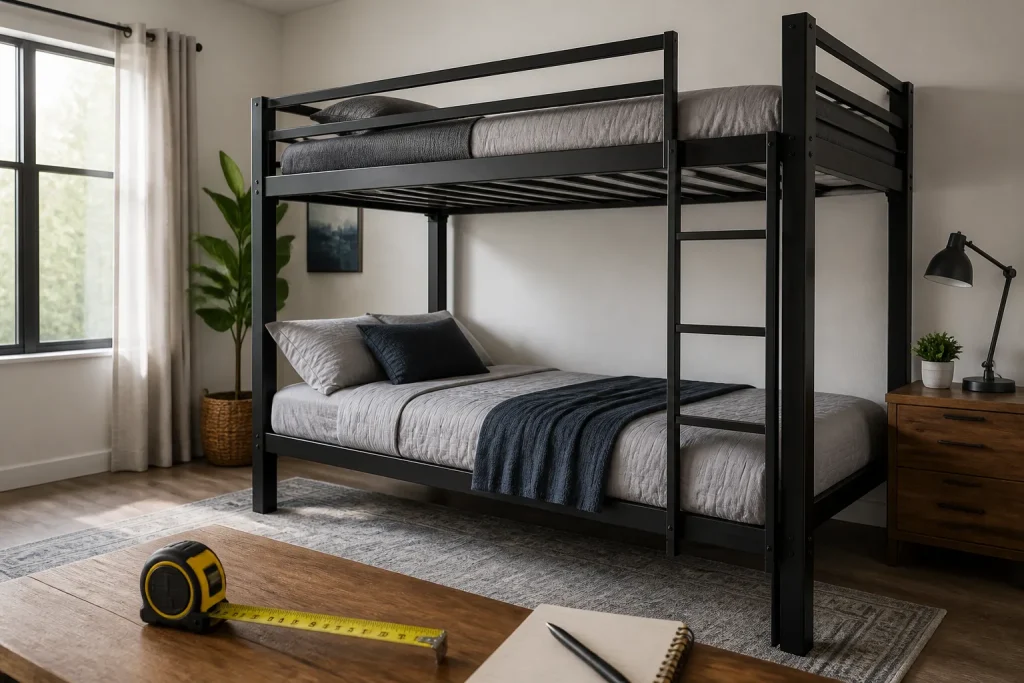
Disclosure: This site may earn a commission if you buy through links on this page or elsewhere on the site. Always check the manufacturer instructions and current safety guidance before buying, building, modifying, or using bunk beds or loft beds.
A heavy-duty bunk bed for adults should be judged by its frame, fastening method, weight rating, and real-world stability—not just by how solid it looks in photos. Adult use changes the requirements: the bed must handle higher loads, more movement during sleep, and often larger mattresses than a typical kids’ bunk.
If you are comparing heavy-duty bunk beds for adults, start with the basics that are easy to verify: the stated weight limit per sleeping surface, the frame material, the type of joinery, the height of guardrails, and the clearance around the bed. A bunk bed that seems sturdy can still be a poor choice if it flexes under load, is hard to anchor correctly, or leaves too little room for safe climbing and sitting.
Table of Contents
Quick Answer
Choose the bed by verified weight rating, all-metal or thick hardwood construction, secure joinery, and low flex during a stability check. For adults, avoid guessing based on appearance; confirm the mattress size, ceiling clearance, ladder or stair design, and whether the manufacturer allows adult use on both bunks.
| Decision | Practical guidance |
|---|---|
| Frame material | Prefer welded steel or thick hardwood with reinforced joints; avoid thin tubing or decorative frames with little structural bracing. |
| Weight rating | Check the limit per bunk, not just total capacity. Use a conservative buffer below the maximum rating. |
| Stability | Look for cross supports, center legs where applicable, anti-wobble hardware, and the ability to tighten all fasteners. |
| Mattress fit | Use the mattress thickness and size the manufacturer specifies so guardrails and headroom stay effective. |
| Room clearance | Measure ceiling height, stair/l,adder space, and the distance from the top bunk to the ceiling before buying. |
| Ongoing safety | Retighten hardware after assembly and periodically after use; replace worn fasteners promptly. |
What makes an adult bunk bed heavy duty
A heavy-duty adult bunk bed is built to support adult body weight with less flex, better joint strength, and more rigid frame geometry than a basic youth model. In practice, that usually means thicker steel tubing, substantial hardwood or engineered wood components with structural reinforcement, or a combination of both. The bed should feel stable when you climb, sit, roll over, and get in and out of it.
The phrase “heavy duty” is not standardized across the market, so the label alone is not enough. Two beds can both be marketed for adults, yet one may be appropriate for occasional guest use while another is designed for routine daily sleeping. Focus on what the manufacturer actually publishes: per-bunk weight capacity, recommended mattress thickness, assembly method, and whether the bed is intended for adult occupants on the top and bottom bunks.
- Look for reinforcement at corners, ladder connections, and center support areas.
- Prefer designs with clearly stated adult weight ratings for each bunk.
- Avoid beds that rely mostly on decorative panels for strength.
- Treat vague terms like “commercial grade” or “extra strong” as marketing unless the specs support them.
Materials: steel, wood, and hybrid frames
Steel frames are often the most straightforward option for heavy-duty use because properly designed welded or bolted steel can offer strong load support and predictable alignment. Look for thicker gauge tubing, gusseted corners, and cross-bracing that reduces side-to-side sway. Finishes matter too, but finish quality is secondary to structure.
Solid hardwood frames can also work well when the design uses thick posts, sturdy rails, and robust joinery. Hardwood is often preferred for a warmer look, but it depends heavily on construction quality. Some wood frames are stable only when every fastener is tight and the slat system is well supported. Hybrid designs can be effective when they use metal for structural members and wood for panels or stairs, but the strength comes from the frame, not the trim.
What to avoid in a heavy-use frame
Be cautious with thin tubular steel that feels light and hollow, particleboard-only assemblies, and beds that use many decorative parts without much structural reinforcement. If the product photos show large gaps in the support system or a lot of small fasteners in non-load-bearing locations, that is not a sign of strength. It often means the frame depends on appearance more than structure.
Weight ratings: how to read them correctly
Weight ratings should be taken seriously and read exactly as written. Many bunk beds list a limit per sleeping surface, while others list a combined limit for the whole unit. Those are not interchangeable. A bed rated at 250 pounds per bunk is not the same as one rated at 500 pounds total if you plan to load one bunk heavily or use both bunks daily.
Use a margin of safety. Even if the listed capacity seems adequate, it is smart to stay comfortably below the maximum rather than treat it as a target. That is especially important when the bed will be used by adults, when mattresses are thicker, or when the frame may see extra movement from sitting on the edge, changing bedding, or getting in and out repeatedly. If the listing does not clearly state whether the number includes the mattress, treat it as uncertain and ask the seller before buying.
| Spec to verify | Why it matters |
|---|---|
| Per-bunk weight limit | Tells you what each sleeping surface can support |
| Total frame capacity | Helps when both bunks will be used regularly |
| Mattress included or excluded | Prevents overloading by assuming the wrong number |
| Ladder capacity | Important if the ladder is attached to the frame |
| Stair or storage support | Needed when steps or drawers add load to one side |
Stability checks before you buy
A bunk bed can meet a published weight rating and still feel unstable if the frame rocks, twists, or shifts under normal use. Stability depends on how the load transfers through the bed. Good designs have multiple points of contact, consistent alignment, and enough bracing to resist racking. Poor designs may rely on a few bolts holding large sections together with little lateral support.
Before purchase, look for product details that mention anti-wobble connectors, crossbars, center support posts, or wall anchoring instructions if provided by the manufacturer. After assembly, check for movement by gently pushing the frame from the side and end, then climbing in carefully and repeating the test. Any noticeable racking, squeaking that worsens under load, or bolts that loosen quickly are signs to stop using the bed until the issue is corrected.
- Check that all fasteners are accessible for retightening.
- Look for a ladder or stair system that attaches securely and does not shift when stepped on.
- Inspect slat spacing and support rails so the mattress is fully carried, not sagging between supports.
- If the bed includes a top guardrail, verify that it is properly installed and meets the manufacturer’s instructions for mattress thickness.
Measuring the room and mattress correctly
Room measurements matter as much as frame strength. A heavy-duty adult bunk bed usually takes more vertical clearance than a standard bed, especially if the top bunk is intended for adult use. Measure floor-to-ceiling height, then subtract the mattress thickness, the frame height, and enough space for a sleeper to sit up without hitting the ceiling. Also account for fans, light fixtures, and sloped ceilings if they are present.
Mattress size and thickness can change safety conditions. A mattress that is too thick may reduce guardrail effectiveness, while one that is too thin may not perform as intended on the slat system. Follow the manufacturer’s mattress specifications closely. If you are comparing options, internal guidance on ceiling height for bunk beds and bunk bed weight limits can help you narrow the field before you commit to a specific model.
Simple measurement checklist
Measure room height at more than one point, especially if the ceiling is uneven.
Measure the intended mattress thickness before ordering the bed.
Confirm ladder or stair footprint so it will not block doors, windows, or closets.
Leave enough clear space around the bed for making it and inspecting hardware.
Assembly, maintenance, and long-term use
A strong design can be weakened by poor assembly. Follow the instructions exactly, keep the bed square during assembly, and tighten fasteners in stages rather than all at once. If the manufacturer recommends two people for assembly, take that seriously; many adult bunk beds are difficult to align safely alone. After setup, recheck hardware after the first few nights of use because small shifts can happen as the frame settles.
For long-term use, inspect the bed periodically. Look for loosening bolts, cracks in wood, chipped welds, bent ladder rungs, or worn support slats. Tighten hardware when needed, and replace damaged parts with approved replacements rather than improvising with random hardware. If the bed starts to creak more, wobble, or tilt, stop assuming it is normal wear and find the cause. For safety-sensitive furniture, small changes can matter.
- Re-torque bolts after initial use and during routine maintenance.
- Do not exceed the listed mattress thickness or weight limit.
- Keep the ladder clear and dry; slippery steps are a practical hazard.
- If the bed will be moved, disassemble it rather than dragging it assembled.
When a heavy-duty bunk bed is the wrong choice
A heavy-duty bunk bed is not always the best answer. If the room has low ceilings, awkward corners, or limited clearance around the bed, a loft or a standard platform bed may be safer and easier to maintain. If the users have mobility concerns, limited balance, or difficulty climbing, a bunk bed can create unnecessary risk even when the frame itself is sturdy.
If you only need extra sleeping capacity occasionally, a trundle, daybed, or separate guest bed may be a better fit. The right choice is the one that matches the room, the users, and the actual load requirements. Heavy-duty bunk beds for adults are useful when space is tight and the structure is clearly engineered for adult use, but they are not a substitute for a good room layout or a realistic safety assessment.
Related Guides
Keep planning with bunk bed games safety ideas, ceiling height for bunk beds, bunk bed weight limits.
FAQ
Are heavy-duty bunk beds for adults safe for everyday use?
They can be, if the frame is designed for adult occupancy, assembled correctly, and used within the stated limits. Verify the per-bunk weight rating, mattress thickness, and available clearance before daily use.
What frame material is best for adult bunk beds?
Steel is often the most straightforward for strength and rigidity, while solid hardwood can also be suitable if the joinery and supports are substantial. The safest choice depends on the full design, not material alone.
Should I buy a bunk bed that is rated close to my weight?
No. Leave a buffer below the published limit. That is especially important for adult use, thicker mattresses, and beds that will see frequent movement.
What should I inspect after assembly?
Check for wobble, loose bolts, uneven contact with the floor, squeaks that suggest movement, and any slat or rail shifting. Re-tighten hardware as needed.
Do adult bunk beds need to be anchored to the wall?
Only if the manufacturer requires it or if the design depends on wall anchoring for stability. Do not assume anchoring is optional; follow the product instructions exactly.